
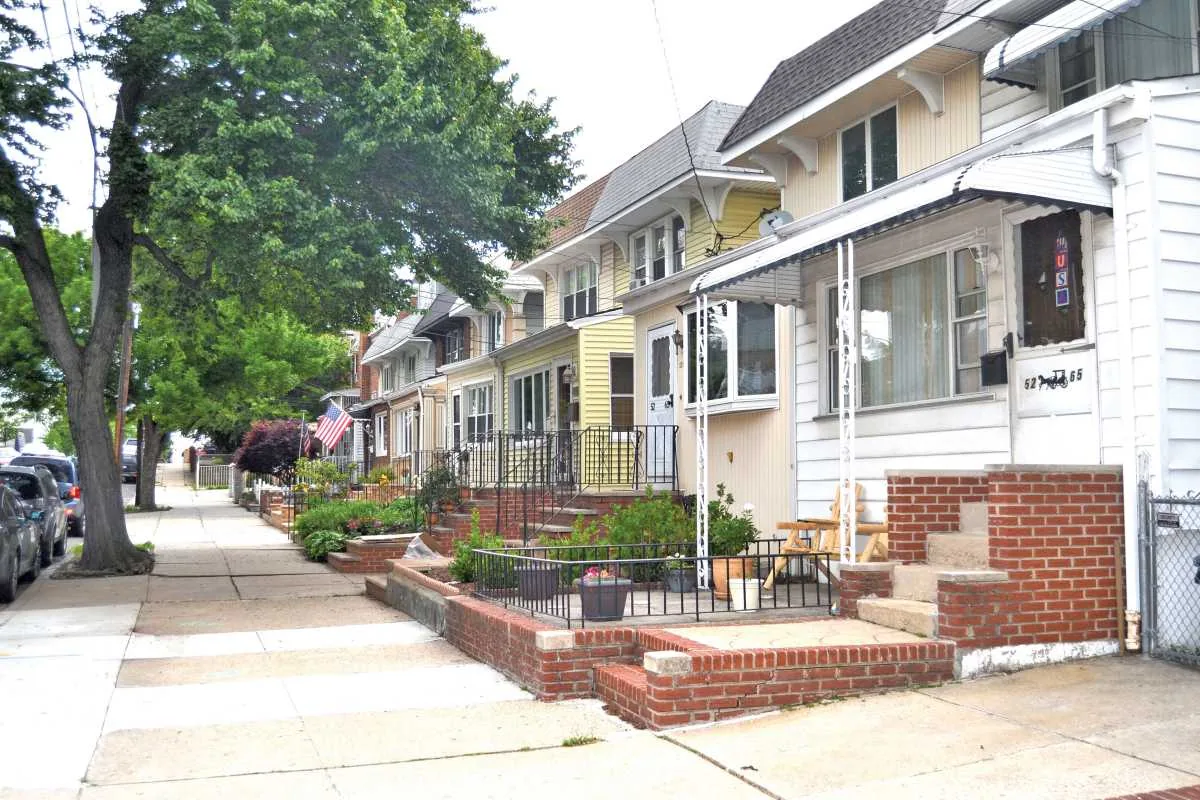
Maspeth, Queens, NY sits low, and its commercial roofs live with that. Mostly industrial lowland, the ground between 43rd and 58th Street includes the former Furman Island, and the Maspeth Industrial Center is crossed by the freight-only LIRR Bushwick Branch. Owners here tend to notice one thing first: standing water on the roof a day after the rain has stopped. We begin with that pond and trace the water back, step by step, from the drain through the seams to the walls.
Along Grand Avenue, the main business street, smaller commercial roofs are checked in the same order, because a small roof with one drain and a shared parapet fails in the same few places as a large one.
What are the commercial roofs like in the industrial lowlands?
An industrial building in the lowlands is likely to be wide and low, with long fields of membrane, a modest number of drains, rooftop units on curbs and parapets at the edge. The roof is the building's largest surface, and weather reaches it from every direction. Flat ground leaves little to slow the wind, so the roof edge carries the load.
Along Grand Avenue and toward Flushing Avenue, which runs west toward downtown Brooklyn, we look at smaller commercial roofs the way we look at any storefront roof: count the drains, check the walls shared with neighbors and read the patches for what they say about past leaks.
Why does water behave differently on low ground?
Hurricane Sandy put water six feet deep in Maspeth in October 2012, a sign of how low the ground lies. A roof is above that water, but its leaders discharge toward the same low ground. When a heavy rain overloads the system downstream, leaders can back up, and a roof that normally drains in minutes may hold water for hours. A pond that stands that long presses on every seam and flashing under it.
That is why the leaders and the connection below the roof are checked along with the strainer on top, since a clear strainer on a blocked leader solves nothing.
Where a leader does back up, an overflow scupper through the parapet or an emergency drain at the roof edge gives the water a second way out. It sits slightly above the main drain, so it runs only when something is wrong, and water coming from it tells the owner to check the main drain at once.
Which parts of these roofs fail first?
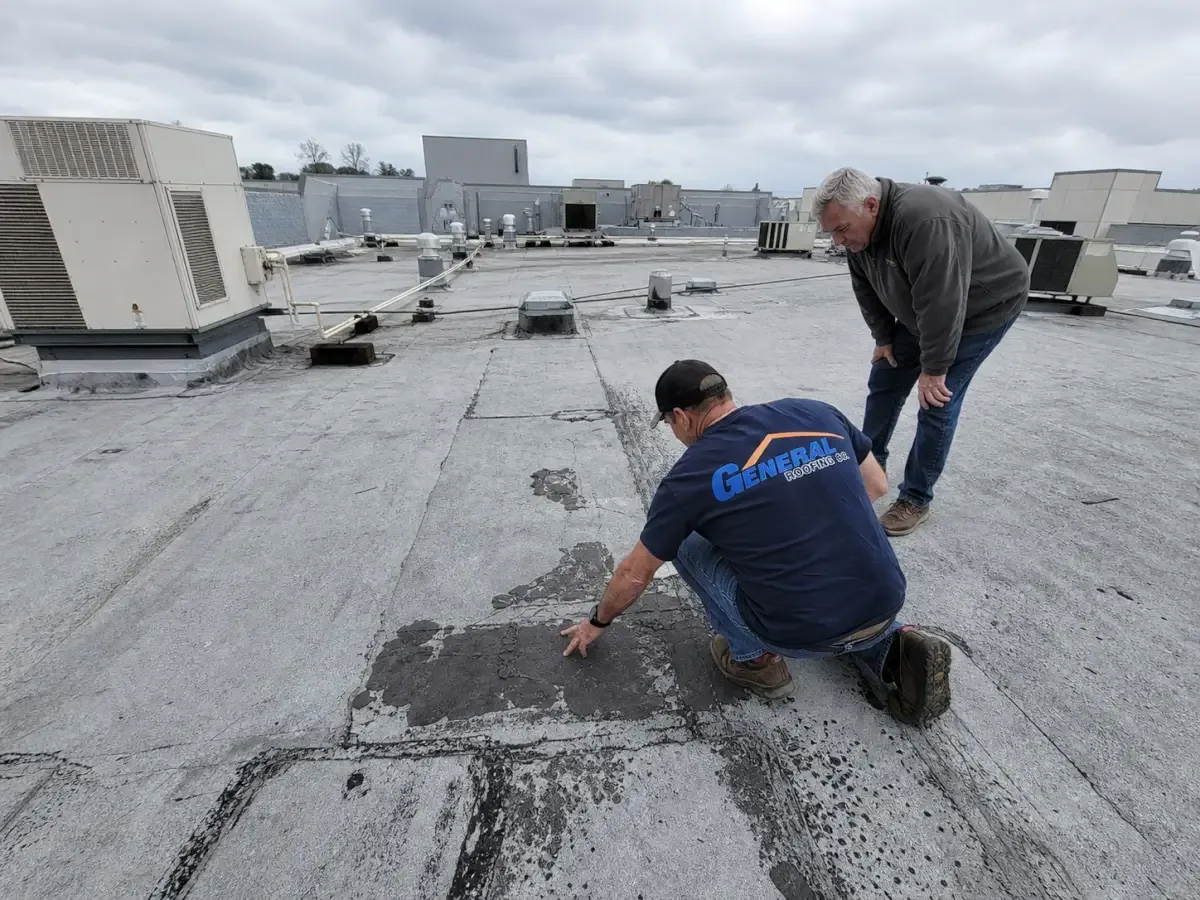
On wide industrial roofs, seams along long runs open where ponding has pressed on them for years. Curbs under heavy rooftop units crack at the corners. Edge metal works loose where wind gets under it. On smaller Grand Avenue buildings, the failure is at the shared parapet, the scupper and the pipe boots. In both cases the stain inside is rarely at the opening, because water travels along the deck before it falls.
Rust is the evidence we look for on a metal deck. A line of rusted fasteners seen from the floor tells us a leak has been running for a long time, and it changes the repair from a patch to a deck inspection.
Wind finishes what ponding starts. With so little around to break it, wind reaches the roof edge undisturbed, and a loose strip of edge metal can peel a long run of membrane in one gust. We check fastener spacing and sealant at the perimeter on every industrial roof we walk.
How do we check what the roof is doing?
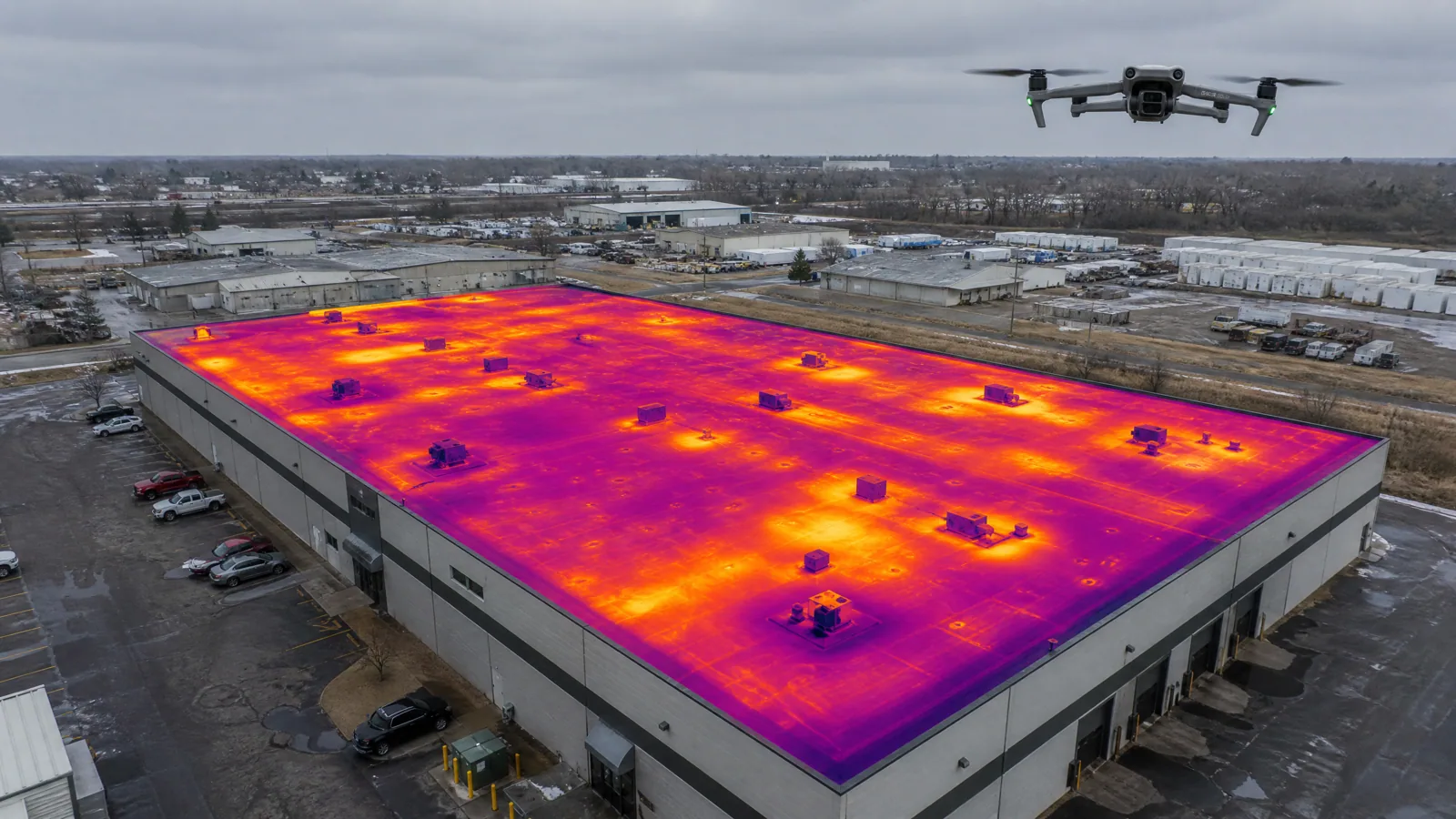
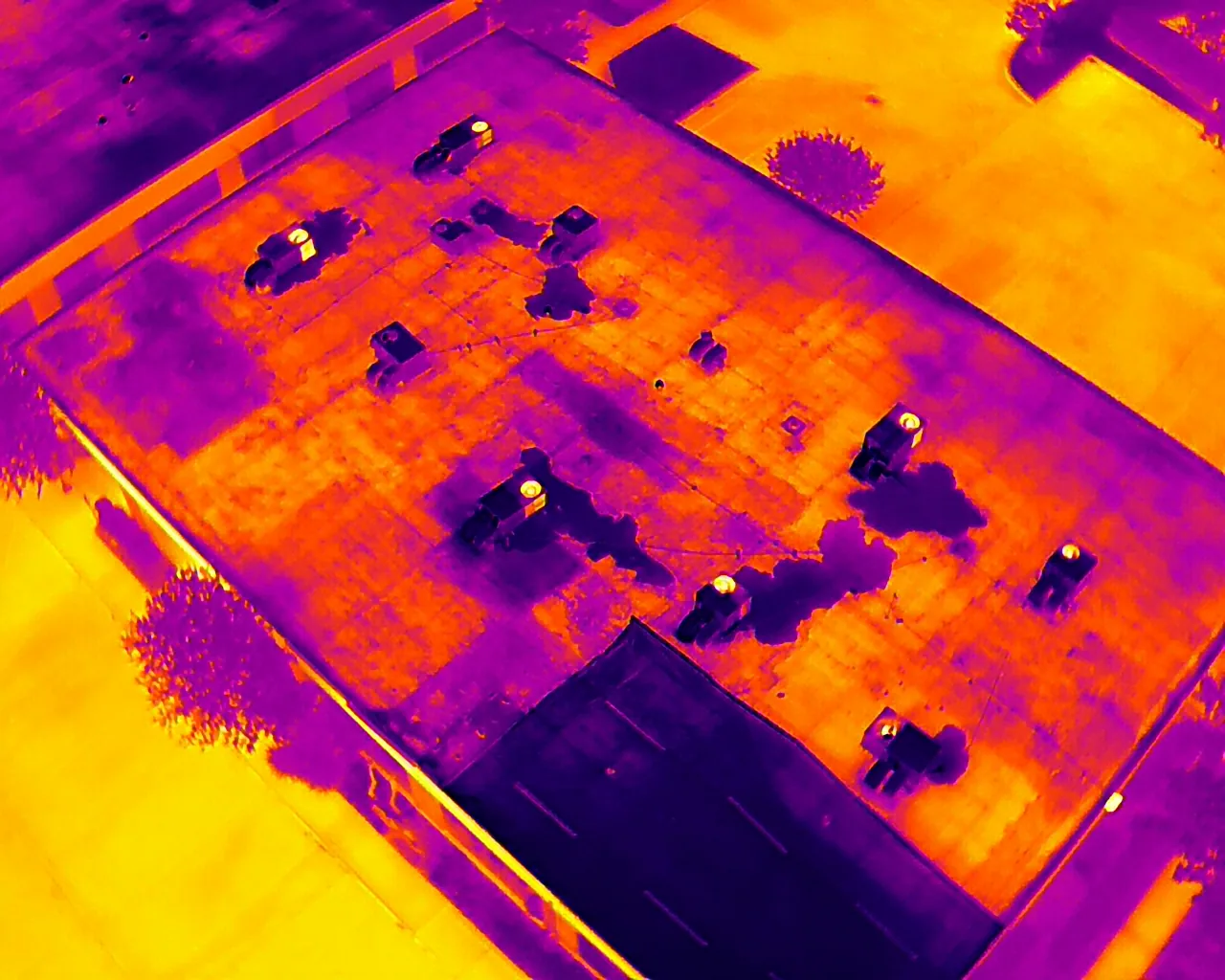
The best time to walk is after rain, while the ponds are still there, followed by the seams, drains, leaders and walls. A drone survey maps the ponds across a wide field in minutes, and an infrared scan finds wet insulation the surface hides. Cores confirm the layers. A written report with photographs ranks the repairs.
Since a freight line crosses the Maspeth Industrial Center, we also look at what settles on the roof, such as dust, residue and debris that can clog drains and cover seams.
What can be done, and what does it depend on?
A repair with a drainage fix may be enough where only a few details failed; a sound membrane over dry insulation may instead get a coating or a recover; wet insulation, a rusted deck or several layers call for replacement. Cost turns on the layers to remove, the moisture, the access and the curbs to rebuild, and a plan to taper insulation toward the drains belongs in any replacement here, since ponding is the failure to design against.
What else does the weather ask?
Snow averages about 30 inches a year across the city, and January 23, 2016 brought 27.3 inches in a day, so a flat roof has to carry a load as well as shed water. Summers sit under a strong heat island. A low district asks a lot of its drains when a storm like Hurricane Ida's remnants arrives, as on September 1, 2021, when the city saw its first flash flood emergency and Queens most of the deaths. Drains are checked before winter and seams after the thaw.
What is the next step?
Photographs of the pond and the drain nearest it start a booking, and we add the street and the roof age when they are known. You will hear what the roof is doing, in plain steps, before any number is discussed. Owners with buildings in Ridgewood or Glendale can combine visits, and those with large storage buildings may compare notes on warehouse roofing.
Questions Owners Ask
What building owners and managers usually ask before a roof visit.
Most roofs should clear within a day. Lingering water points to a low spot in the deck, a backed-up leader or a blocked drain, and a pond that stays two days or longer ages the membrane and finds weak seams. The depth gets measured, the drain cleared and the leader checked, and then comes the decision on whether the deck needs tapered insulation.
It means the leak has been running long enough to attack the steel. We check how far the rust has spread from below and from above. Small areas can be treated and patched, and larger ones need the deck sections replaced before a new membrane goes on. A recover over a rusted deck would hide the problem and shorten the new roof's life.
Yes, in most cases. We work bay by bay, dry in each by the end of the day and protect the stock and equipment below. Dock traffic is kept clear and noisy tasks are scheduled for lighter periods. The plan goes to the operations manager before the first day.
Because two roofs, two owners and two repair histories meet at one wall. The flashing is cut, lapped and sealed by different hands at different times. We expose the old flashing, check the masonry and rebuild the junction with a termination bar and sealant, and we tell the neighbor before the opening is made.
A check after every heavy rain, a full clean-out in fall, a look at the leader connection once a year and a test of the overflow. Keep a photograph log with dates, because it shows whether a drain is slowing over time. A routine like that takes under an hour a visit and prevents most of the ponding we see.
Related Roofing Work
Other pages that connect to Maspeth.
Drone Roof Inspections
Drone imaging for large or hard-to-reach commercial roofs in Queens, NY, with photographs and thermal data that guide a safer hands-on follow-up.
Infrared Roof Moisture Surveys
Infrared scans and core-cut moisture surveys for Queens, NY commercial roofs that locate wet insulation before the owner commits to repair or replacement.
Commercial Roof Repair
Planned repair of membranes, seams, flashing and details on Queens, NY commercial roofs, with each fix explained before the crew picks up a tool.
Ready to Talk About Maspeth?
Tell us about the building and what you are seeing. We will schedule a roof walk and send photos and a written scope.