
About Commercial Roofing Contractors of Queens
A commercial roofing contractor working on flat and low-slope roofs across Queens, NY.
Most owners meet us after a stain appears on a ceiling, and our first question is where the water was trying to go. Commercial Roofing Contractors of Queens is a commercial roofing contractor working across Queens, NY. Our work on low-slope and metal roofs covers repair, replacement, recovers, restoration, coatings, inspection and maintenance, for warehouses, retail centers, apartment buildings, offices, clinics, schools and industrial buildings.
Welded and rubber single-ply sheets (TPO, PVC, EPDM, KEE), asphalt-based roofs of the modified bitumen and built-up kind, metal in both standing seam and retrofit form, sprayed foam, and liquid coatings in silicone or acrylic make up the systems we install and repair. Alongside them we offer hands-on inspections, drone and infrared moisture surveys, written condition reports with photographs, preventive maintenance programs and documentation for insurance claims. When a roof opens in the night, a crew answers, any day of the week, holidays too.
How does a first visit work?
The visit is on foot, and it follows an order. We start at the drains, because the roof shows its trouble there first. We clear the strainers, pour water into the drain and watch how fast it leaves. Then we probe the seams with a blunt tool, look at the flashing at every parapet and curb, and check each penetration. We photograph what we find and mark it on a roof plan.
On a large roof, or one where the insulation may be wet, an infrared moisture survey is added, usually on a clear evening when wet insulation holds heat longer than dry. A drone covers edges and high areas that are hard to reach. A warm patch on the scan earns a core cut, which lets the owner see the layers and the water directly.
After the visit we explain in plain steps what the roof is doing, before a price is mentioned: what we saw, what it means and what the options are. The owner decides what happens next, and no work begins until that decision is made.
The order of the visit never changes, whatever the size of the roof. A corner shop gets a short walk and a large industrial roof gets a long one, and both begin at the drain. That consistency is what makes our records comparable from one visit to the next.
What do we do after the visit?
Most roofs need repair before they need anything bigger. A roof repair rebuilds the flashing, seam, boot or drain that failed. When a roof is past repair, three paths open. A recover lays a new membrane over a base that is dry and sound, a coating prolongs a membrane that is bonded and dry, and a replacement strips the roof to the deck.
The core sample and the moisture scan choose among these. If the insulation is wet, a coating or recover would trap the water, and we say so. If the roof is dry and bonded, a replacement would spend money the roof does not need to spend. The scope we write names each item, its location and the cost drivers beside it, so an owner can see why a price is what it is.
Which buildings and owners do we work with?
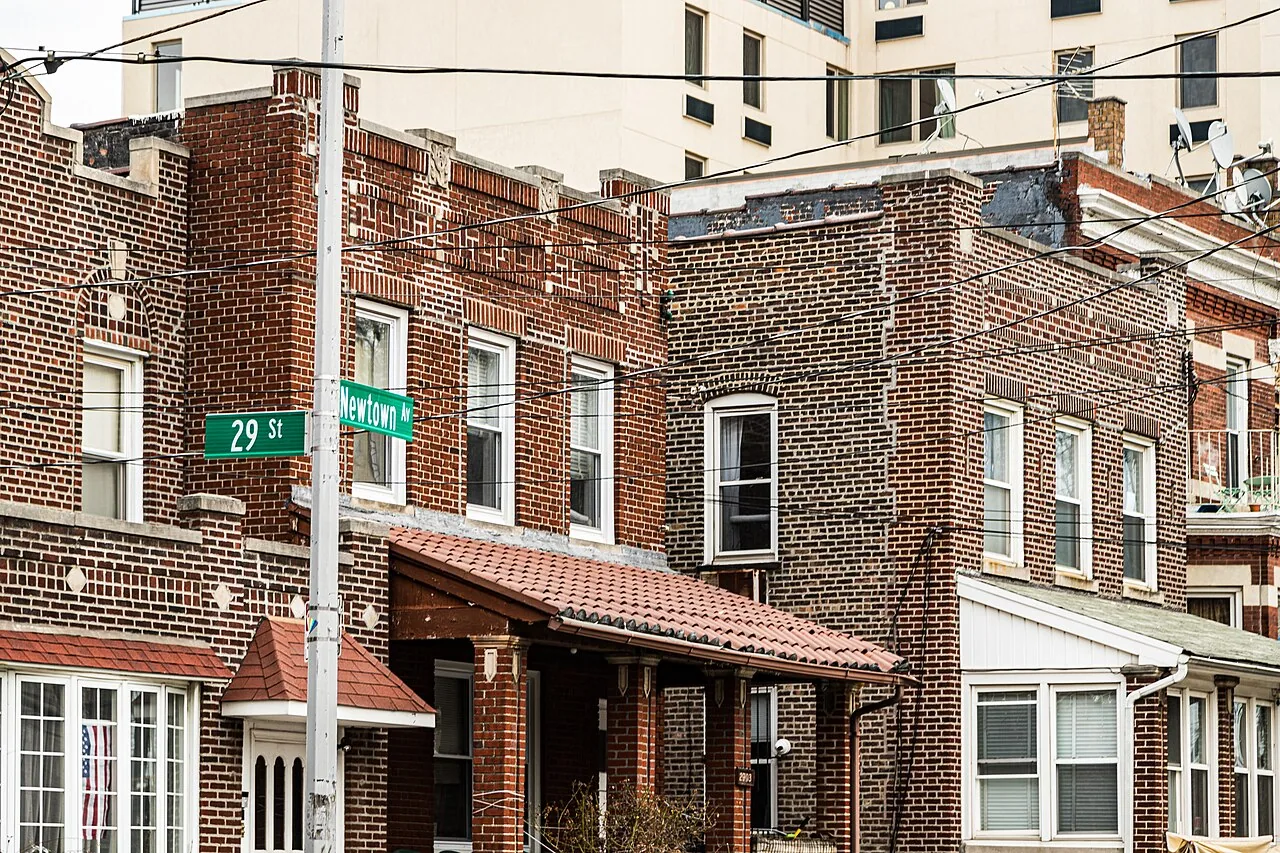
Queens has the most diversified economy of the five boroughs, and its roofs reflect it. Our roofs include Long Island City's converted factories and bakeries, the industrial lowlands of the Maspeth Industrial Center and the roughly 550 acres of College Point Corporate Park. Yellow-brick rowhouses from the early twentieth century and mill-era stock define Ridgewood and Glendale, while Rego Center Phase II adds 950,000 square feet of retail along 62nd Drive.
Our owners are as varied: property managers, investors, healthcare systems, school districts, retail and restaurant operators, logistics firms and contractors. Each one reads a roof differently, so the report is written for all of them. A manager gets a ranked list. A lender gets a condition rating. A board gets a scope in sections, with a cost for each.
How do we work around tenants and operations?
We work on occupied buildings. That changes the plan, not the standard. We protect entrances, stage materials away from doors, schedule loud and odorous steps for agreed hours and close the roof watertight each evening. On a restaurant roof, we keep fumes away from air intakes. On a hospital roof, we work with the facility team on noise, dust and infection control. In a school, we use the summer window.
Queens streets bring their own limits: narrow blocks, no loading zone, a lift that needs room, a shared parapet with a neighbor. We plan the hoist, the delivery and the path of materials before the first day, and we talk to the people who need to know.
Notice matters. Tenants, residents and staff hear from the manager before the crew arrives, and a named contact answers questions on the day.
What weather do the roofs have to survive?
Roofs in Queens fail from water that has nowhere to go. Hurricane Ida's remnants struck on September 1, 2021, and the first flash flood emergency in city history followed, with Queens suffering the bulk of the deaths. Water stood six feet deep in Maspeth after Hurricane Sandy in October 2012, and the entire Rockaway peninsula had been placed under a mandatory evacuation order. Winters bring about 29.8 inches of snow on average, January 23, 2016 produced 27.3 inches in a day, and summers sit under a strong heat island that saw LaGuardia, in Queens, reach 107 degrees on July 3, 1966.
Those events teach one lesson: a roof fails at its drains, edges and details long before it fails in the field, which is where maintenance programs start. The Department of Buildings publishes the 2022 NYC Construction Codes, whose chapter on roof assemblies and rooftop structures bears on how work is designed, and we build what the approved design calls for.
What does the owner receive?
Every job ends with a closeout walk and a record: photographs of the corrected details, the materials used, a roof plan showing what was done, and a note about anything to keep an eye on; owners keep it in the roof file. It supports a warranty question, an insurance claim, a sale or the next manager. Our condition reports and capital plans build on that record, so a roof's history stays in one place.
To begin, send a few photos of the stain and the area around the drain, and the first answer you get describes the roof in plain steps, with price after.
Commercial Roofing Questions
Do you do emergency work at night and on holidays?
Yes, at any hour and on holidays. A crew dries the building in first, and the permanent repair is planned afterward.
Will you tell me if my roof does not need replacing?
Yes. The core sample and the scan decide. If a repair or a coating will do, that is what we propose, with photographs showing why.
Can you work while the building stays open?
Yes. An occupied building is the usual case, so hours are agreed, entrances protected and the roof closed watertight each day.
What do I need to send to begin?
Photos of the stain and the drain area are enough to start. If you also know the roof age and the address area, we can decide what kind of visit to schedule.
Do you handle insurance paperwork?
We document the roof's condition with dated photographs, moisture maps and a written scope. Coverage decisions stay with the insurer and the owner's broker.
Request a roof assessment
Tell us about the building and what you are seeing. We will schedule a roof walk and follow up with photos and a written scope.