
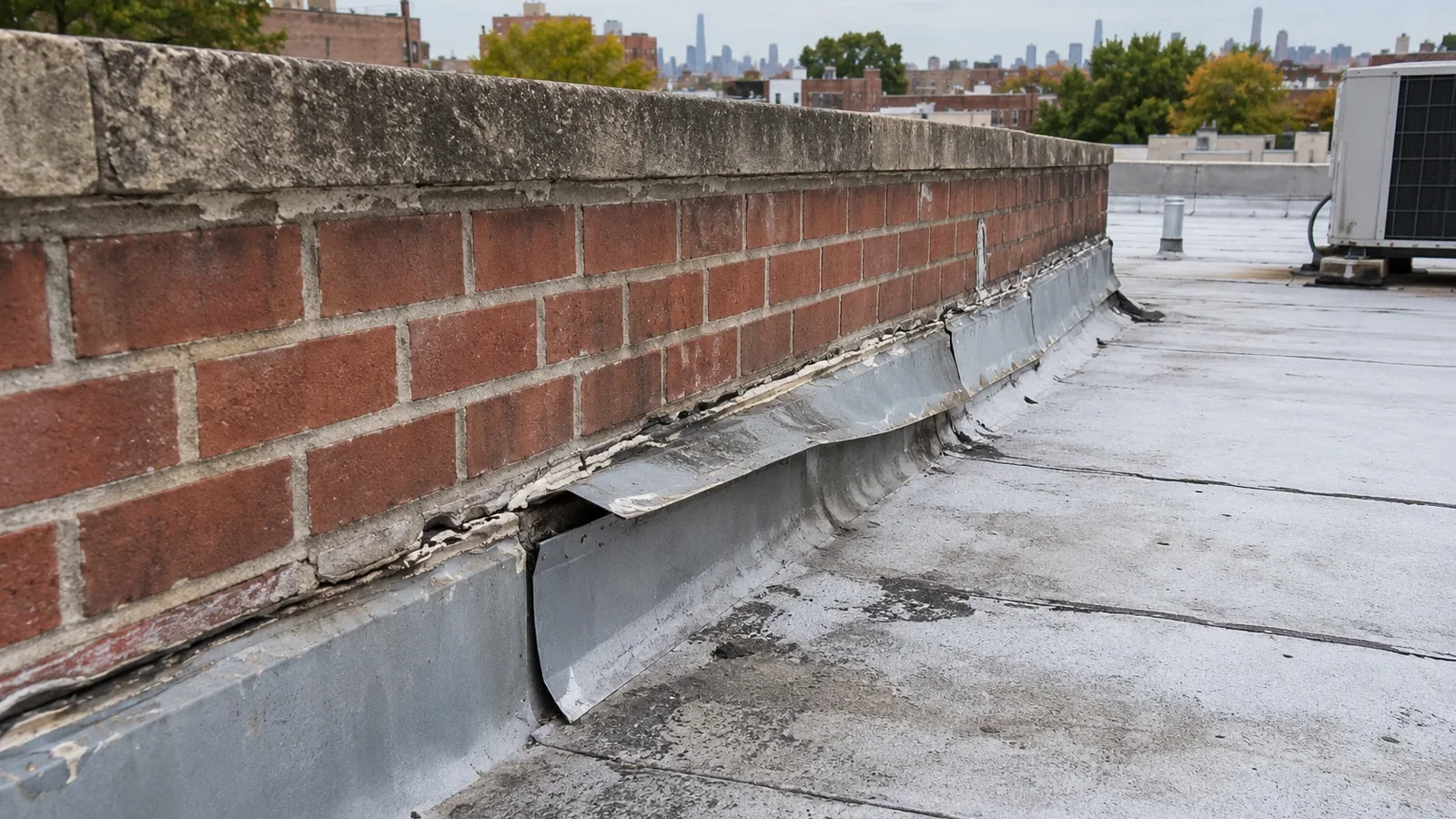
The tar at the foot of a parapet has gone from black to gray, and it flakes away under a fingernail. That is how most owners first meet a failed flashing: not as a hole, but as a material that has quietly aged out. Behind the crumbling strip is the joint where the roof meets a wall, and every drop of water that runs down the wall ends up there.
Flashing seals the places where the flat membrane has to stop. At a wall, a pipe or a curb the membrane has to rise, and a cap or counterflashing over the top edge throws the water out and away. Each of those turns takes more strain than the open roof, because the building moves against the membrane there, and sun and cold work on a small, stiff strip of material. On Queens, NY roofs we walk the details before we look at anything else, since leaks begin there.
What counts as flashing?
Base flashing runs up the sides of walls, parapets, curbs and equipment, usually eight inches or more above the roof surface. Counterflashing or a cap sits over the top of it and covers the termination. Pipe flashings seal around vents and conduits. Edge flashings finish the roof at its perimeter. Each is made of membrane, modified bitumen, metal or a liquid-applied material, depending on the roof.
The fastenings are part of the flashing too. A termination bar that has loosened, a sealant bead that has split, a fastener that has backed out of a wall are all flashing failures, even though the sheet itself looks intact.
Not every flashing sits on a wall. On a flat roof in Queens, the most common failures we meet are at parapet bases, rooftop unit curbs, pipe penetrations and the line where a roof steps up to a higher neighbor. Each has its own habits, and each is covered by the same principle: water must be directed over the top of the flashing, never behind it.
Why does flashing fail?
The usual causes are movement, age and water behind the top edge. A roof and a wall expand and contract at different rates, so the joint between them works open over many seasons. Sealant and tar harden with sunlight and crack. A termination sealed only with caulk lets water in as the caulk shrinks. And on masonry, water that enters through a cracked mortar joint above the flashing runs behind it and pushes it off the wall.
Yellow-brick rowhouses and mill-era buildings, many inside historic districts, define much of Ridgewood and Glendale. On masonry of that age we look for open mortar above the flashing, and a mason may need to work before the roofer so the flashing has a sound wall to hold it. In Ridgewood and Glendale, the wall gets probed first.
Weather adds strain. Metal and sealant at flashings expand in summer: LaGuardia hit 107 degrees on July 3, 1966, and the heat island keeps Central Park near 85 on an average July afternoon. A dark membrane grows in that heat while a stiff base flashing resists, so the joint is stressed every summer afternoon. In winter, an average 29.8 inches of snow and the freeze-thaw cycle pull everything back, and any small crack takes in water that then expands as it freezes.
How do I recognize a flashing failure?
Look for gaps between membrane and wall, cracked or missing sealant, a sheet that has lifted or buckled, metal caps that rock when pressed, rust streaks and stains below the roofline. Indoors, leaks at a perimeter wall, beside a rooftop unit or around a pipe often start at flashing, and a stain that shows only in wind-driven rain often means a counterflashing that no longer sheds sideways water.
To prove it, we run a hose over one detail at a time, beginning at the lowest point and climbing while someone watches the ceiling. It is the method behind commercial roof leak repair, and it keeps a sound flashing from being replaced while the real opening is a short distance off.
Failures come in groups. One open flashing usually means its neighbors on that wall share the cause, so the full length of the wall is walked, probed and pressed. A wind-lifted edge and a split seam often appear beside a failed flashing, and we look for both in the same pass.
How is flashing repaired?
A repair rebuilds the detail instead of covering it. We cut the old flashing back to sound material, clean and prime the wall, set new base flashing and join it to the field membrane by welded or adhered seam, and finish with a counterflashing or termination bar fastened and sealed at the top. On masonry, the mortar joint above is repointed and a reglet, the groove cut into the wall to receive the cap, is formed or renewed.
Around penetrations, a boot or formed flashing replaces a bead of sealant. Equipment curbs receive new base flashing and caps, in the same order as any skylight and penetration flashing job, and at the roof edge the edge metal and coping get examined during the same visit.
What does it cost to wait?
Every rain finds a failed flashing, and the water travels where nobody can see it: into the wall, along the deck and into the insulation. A repair worth a day of labor can grow into a wall repair and an insulation replacement. The cost drivers are the length of flashing, the height of the wall, the condition of the masonry, the number of penetrations, access and how much wet material turns up. Sealant alone is cheap but short-lived, and a rebuilt detail lasts far longer.
Timing is practical. Sealants and adhesives need warmth and dry weather to cure, which makes spring and fall the best months for flashing work. A winter leak gets a mechanical temporary seal, with the permanent rebuild held for better conditions. On an occupied building the job moves along the wall in sections, each closed watertight before the crew goes home, and tenants are told in advance with interior protection placed before the first cut.
Questions Owners Ask
What building owners and managers usually ask before a roof visit.
Only a temporary one. Cement and sealant crack with the next swing in temperature and hide the problem. A lasting repair rebuilds the flashing in new material, ties it to the membrane and fastens it at the top.
Usually at least eight inches above the roof surface, and more where snow or ponding is likely. The manufacturer's detail and the code set the number, and we follow whichever is stricter.
If the wall above has open mortar or loose brick, yes, because flashing fixed to a failing wall will fail with it. We coordinate so the repointing is done before the new flashing goes on.
Wind drives rain sideways into joints that vertical rain never reaches. A counterflashing with a narrow gap, or a reglet that has cracked, leaks from one direction only, and aiming the hose at it from that side normally brings the leak back.
Send photos of the crumbling tar and the wall base, any stain indoors, and a note on the weather the day it leaked. We can then explain, step by step, what the flashing is doing, with price afterward.
Related Roofing Work
Other pages that connect to Flashing Failure Repair.

Ridgewood
Commercial roof repair and replacement in Ridgewood, Queens, NY: mill-era masonry, Myrtle Avenue storefronts and mixed-use rows in historic districts.

Glendale
Commercial roof repair and replacement in Glendale, Queens, NY: Woodhaven Boulevard big-box roofs, rail-yard industrial buildings and historic Kreischer brick.
Commercial Roof Leak Repair
Tracing and stopping active commercial roof leaks in Queens, NY, using moisture mapping, water testing and targeted repair, explained in plain steps.
Ready to Talk About Flashing Failure Repair?
Tell us about the building and what you are seeing. We will schedule a roof walk and send photos and a written scope.