
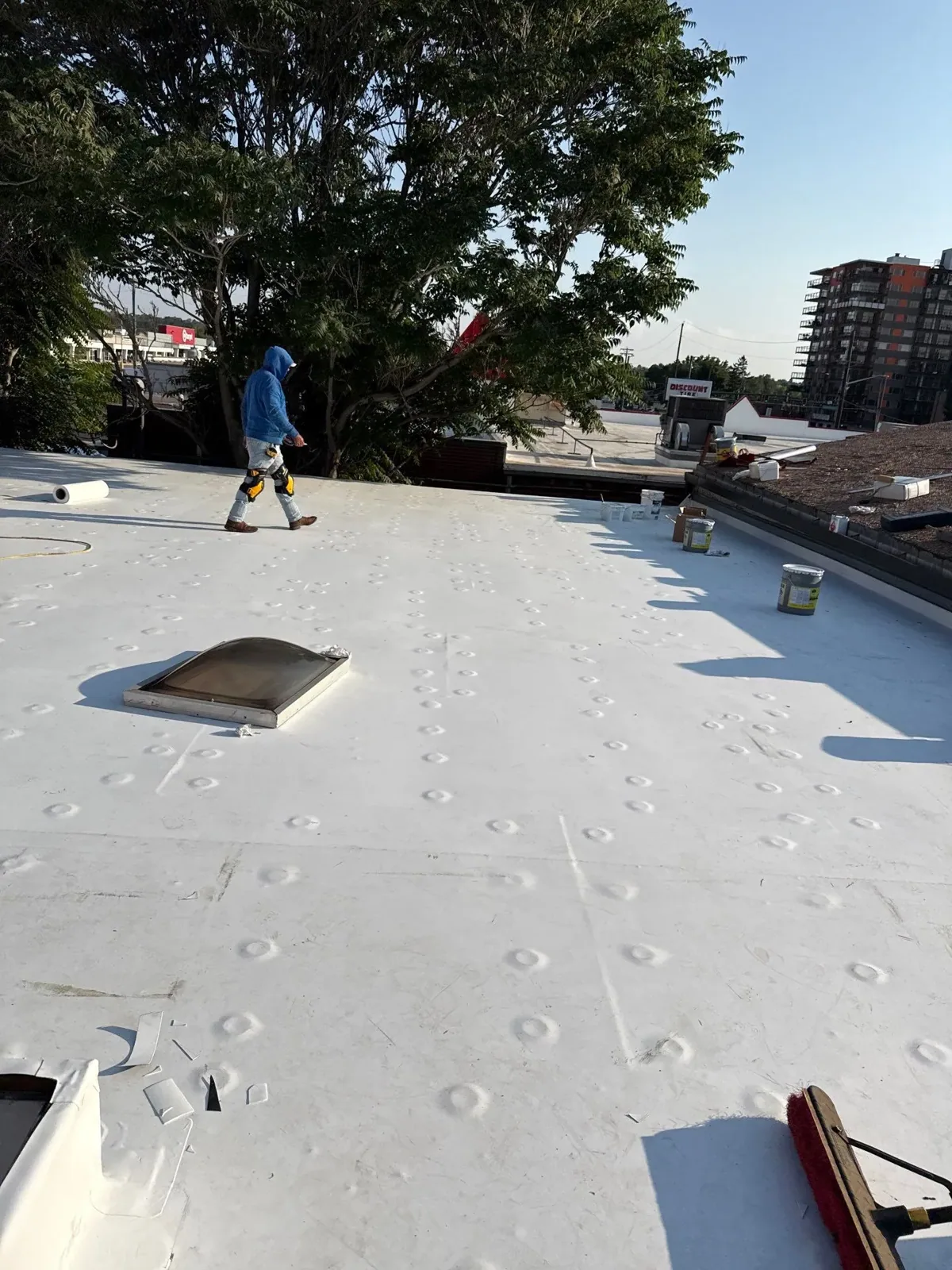
Ceiling stains lined up in a straight row are among the best clues an owner can hand us, because water seldom travels in a line unless something straight is steering it. In a roof the most common straight thing is a seam, the line where two sheets of membrane meet and were joined.
Each seam is a made joint, whether welded, taped, glued or torched, and at every one the roof is only as good as the bond. Heat and cold, standing water and building movement test that bond for years, and when it gives, the roof opens along a line that water finds. Seam failures are among the most frequent repairs on Queens, NY roofs, and among the most repairable when caught early.
How are seams made, and how do they fail?
The sheets of TPO and PVC roofs are welded with hot air that melts the two surfaces together. EPDM seams use adhesive or tape, and modified bitumen laps are torched, mopped or self-adhered. Every method has its own way of failing: a weld that never fully fused, a tape seam peeling because of dirt or moisture sealed in during installation, a bitumen lap that opens as the material ages and shrinks.
Contamination during installation, thermal movement, standing water, ultraviolet damage to exposed edges and repeated foot traffic across a lap cause most failures. A roof moves with the swing between hot days and cool nights, and LaGuardia reached 107 degrees on July 3, 1966. Winter adds freeze-thaw, and the 29.8 inches of snow the city averages ends up in every low joint.
Seams also fail where they meet something else. A field seam joining a wall flashing, a pipe boot or a drain is a stress point, and a flashing failure often first appears as an opening in the nearest seam. Fixing one means checking the other, because they share the same movement.
How do we find a failing seam?
A rounded-tip tool is drawn lightly along each seam edge with about a thumb's pressure. Sound seams push back, failed ones give way and let the tool slip under the edge. We also watch for fishmouths, where the top sheet curls up and leaves a gap, for blisters along the line, for dirt working into the lap and for edges lifted by the sun.
Every defect goes on the roof plan, which shows the owner how many there are and where they cluster. The location of the failures tells the story. Seams that fail beside a pond implicate ponding water, a line of failures along one edge implicates wind, and failures scattered over the entire field implicate age or poor installation, which puts the whole roof in question.
A pull test is the second check. On a welded roof we cut a small strip across a suspect seam and pull it by hand or with a gauge. A sound weld tears the membrane before it separates, while a cold weld peels cleanly, and that shows whether the failure stands alone or signals a weld pattern needing review. The result is noted on the plan and the owner receives photographs of the test.
What does the repair involve?
A short open section is cleaned, dried of trapped moisture and rewelded or re-adhered, while a longer failure gets a cover strip welded or taped across it. At a T-joint, where three sheets come together, the junction gets a patch with rounded corners, because square ones curl. Every patch is probed afterward and a sample is pulled to test weld strength.
On modified bitumen, open laps are warmed and pressed down and then covered with a reinforced strip. On EPDM we use a tape and primer compatible with the existing sheet and try them on a small area first. Dry weather is the time for this work, since moisture and cold interfere with bonding. Our ordinary commercial roof repair includes a check of the neighboring seams so a weak one is not left beside the one we fixed.
The edge of each patch becomes the next weak point, so corners are rounded, edges pressed firmly and all four sides probed. The manufacturer-approved wash cleans the surface, which is left to dry before bonding. Repairs made in a rush on a wet roof are the ones that open again by the next season.
When is it more than a seam repair?
When many seams stand open across the roof, age or poor installation is the likely cause, and patching them one at a time turns into a cycle of return visits. We count failures for each hundred feet of seam and weigh the number against what a repair budget can sensibly hold. An infrared moisture survey checks for wet insulation as well, since open seams let water into the layers below over time.
The question arises most on large industrial and retail roofs. Seams run long on big roofs near Sunnyside Yard, a 192-acre rail yard beside the Degnon Terminal industrial complex, and on the 950,000 square feet of retail at Rego Center Phase II on 62nd Drive. Where a survey finds widespread failure on a roof of that scale, we set out the choice between a coating, a recover and a replacement, with cost drivers beside each.
What does it cost to wait?
An open seam leaks with every rain and gives the wind a place to lift the sheet. One that could have been rewelded in a short visit grows into a torn section and then a wet insulation problem. Cost follows seam length, roof system, access and the amount of wet material found. Owners in Long Island City and Maspeth with older roofs are well served by a seam walk each spring and fall, since the repairs found then are small.
Prevention costs little: keep ponds off the laps, keep foot traffic on walk pads and clear debris that traps water against a seam edge. A wind-damaged corner should be mended before the next gust, since a lifted edge pulls on the seam beside it. Probing every seam during the spring walk is enough to catch most failures while they are small.
Questions Owners Ask
What building owners and managers usually ask before a roof visit.
Not dependably. A weld or seam tape bonds with the sheet, but caulk only sits against it and cracks when the roof moves. The lasting repair joins the sheets again or bridges the seam with a compatible strip.
On a sound membrane, as long as the roof around it. On an aged, shrunken sheet the edges of the repair may be stressed again, which is why the neighboring seams are checked.
Picture the curled-up edge of a lapped seam, opened into a gap like a small mouth. Bitumen laps and seams under tension are where it appears, and the edge has to be re-bonded and covered.
It can. A lap that people cross again and again, especially a weakly bonded one, gets worked open, and pads along the routes to equipment spare the seams as well as the field.
Please send photos of the ceiling stains in their row, the roof area above and any visible seam lines, and note the date of the last rain. We will describe what the seams are doing, step by step, ahead of price. A rough roof age helps too, because it tells us whether we are looking at old welds or new ones.
Related Roofing Work
Other pages that connect to Seam Failure Repair.
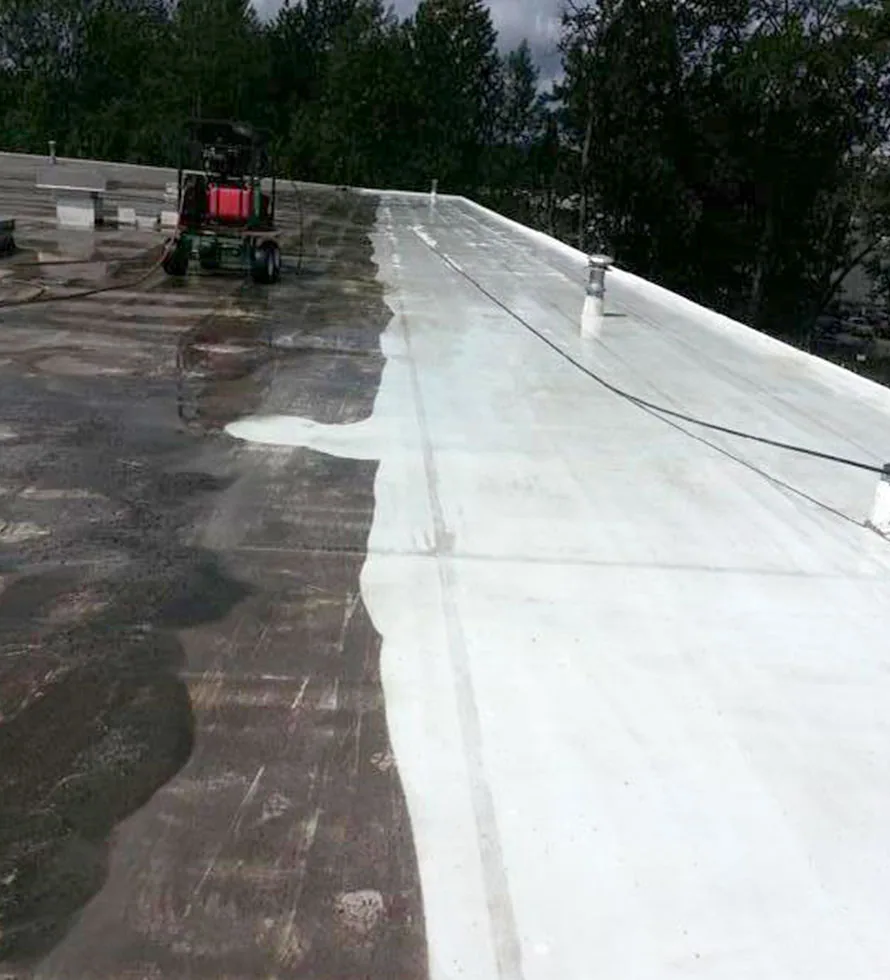
TPO Roofing
TPO roofing in Queens, NY: heat-welded white single-ply membranes for flat commercial roofs, with seam checks, repair and replacement explained step by step.
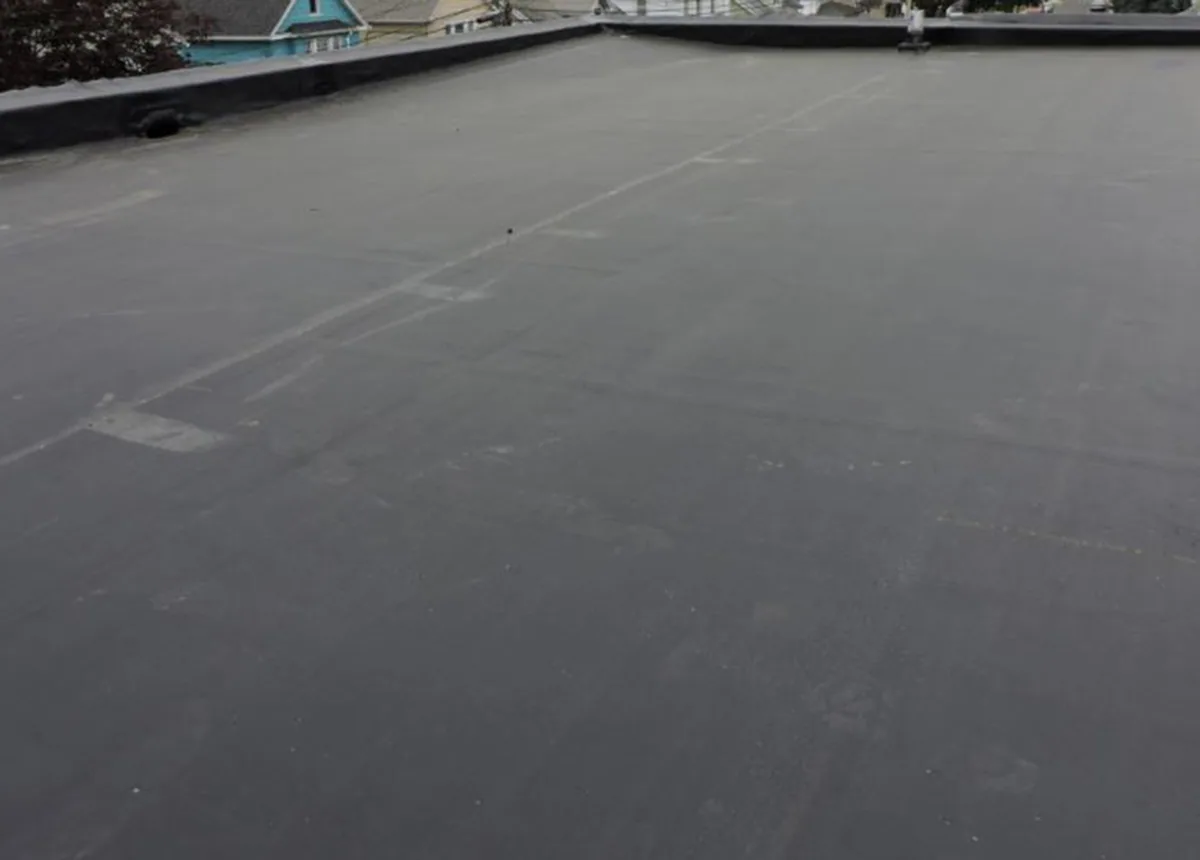
EPDM Roofing
EPDM rubber roofing in Queens, NY: adhered and ballasted membranes, seam and flashing repair, and when a black rubber roof is the right choice for a flat roof.
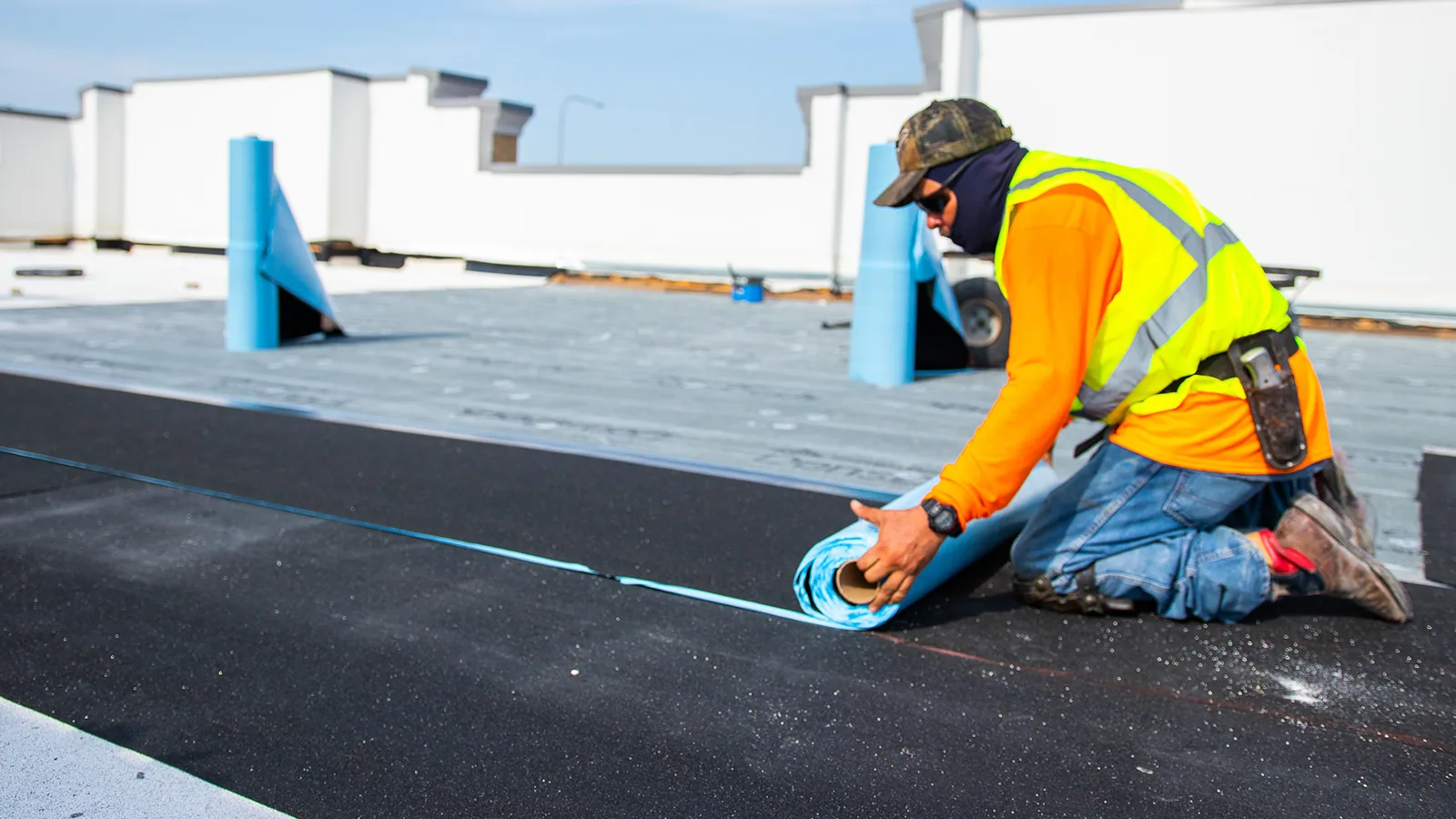
Modified Bitumen Roofing
Modified bitumen roofing in Queens, NY: SBS and APP rolled membranes for old masonry and mill-era buildings, with lap, blister and flashing repair explained.
Ready to Talk About Seam Failure Repair?
Tell us about the building and what you are seeing. We will schedule a roof walk and send photos and a written scope.