
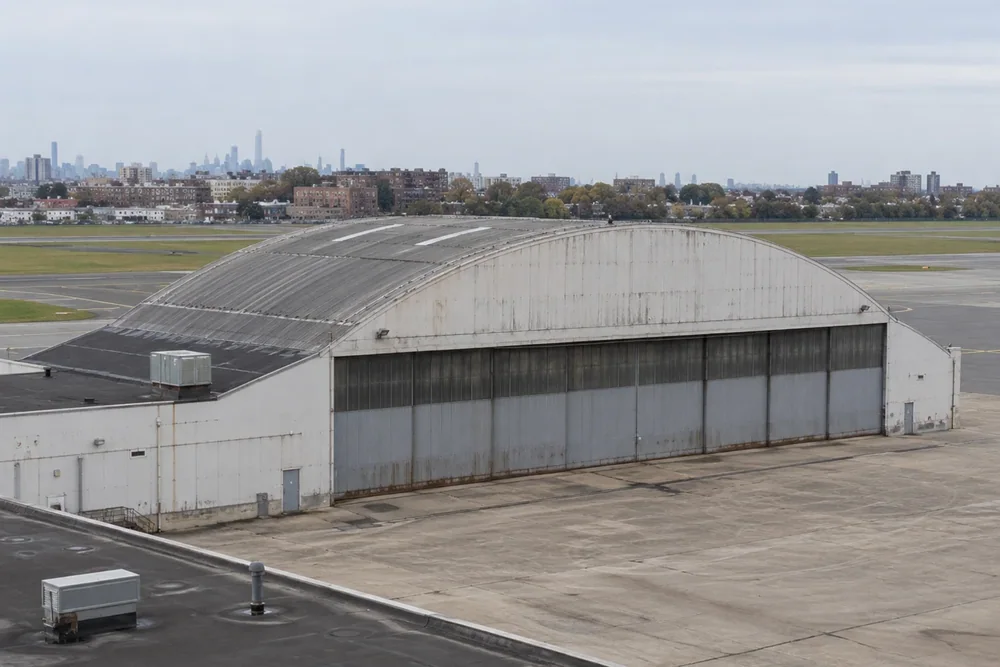
A rust streak running down a hangar column from the underside of a purlin is a record of every rain that has found the same lap. Hangar managers usually see the streak before they see a drip, and the drip, when it comes, tends to land a long way from the opening that caused it. On a roof this long, water travels along a purlin or a steel flute for many feet before it drops, so the question that matters is where it came in, not where it fell. We repair and replace commercial roofs in Queens, NY, and for an aviation building we work from the wet spot back toward the entry, one step at a time.
Walk it with me from the floor up, and the roof explains itself.
What does the hangar manager see first?
What reaches the manager is rarely the roof itself. It is a wet patch on the floor near an aircraft, a stained insulation blanket, a panel lap that shows daylight from inside, or a drip that comes and goes. A drip that follows rain and lands in the same place points to a fixed entry such as a fastener or a lap. A drip that shows up on cold, clear mornings and spreads over a wide area points to condensation on a cold metal skin. A rust bloom below the ridge points to a ridge cap that has stopped sealing.
We ask the manager to log the date, weather and location of each drip with a photograph. Set against the roof plan, the log shows whether one opening or several are at work.
Sprinkler heads and their supply piping are hung from the roof framing, which makes a wet deck or a rusting purlin a life-safety concern, and the report calls out any leak path that passes over that piping.
What is happening on a very long roof?
Aviation buildings usually fall into one of two roof types: a metal roof, standing seam or lapped panels, on steel framing, or a low-slope membrane over insulation on a metal deck. Neither has many penetrations, but the few it has are important: translucent light panels, suppression risers, exhaust vents and the heavy header above the hangar door. On a metal roof, daily heating and cooling works the fasteners loose and splits sealant at the laps. On a membrane roof, a long run to a small number of drains means ponding is the first symptom.
The order of the walk matters. The door head comes first, because the opening at the front moves in every gust and carries a flashing that works harder than any other on the building. Then the laps and fasteners on the weather side, then the ridge and eave closures, and the drains or gutters last. A walk settles which roof type a given building has, so nothing is assumed beforehand.
A translucent daylight panel has its own laps and sealant and ages faster than the steel beside it, so a yellowed or crazed one is replaced before it lets go.
How do JFK and LaGuardia shape the questions we ask?
Spread over 5,200 acres of Jamaica, JFK Airport moved 1,557,067 US tons of cargo in 2025. LaGuardia lies in East Elmhurst, where the Marine Air Terminal is a city landmark and Vaughn College of Aeronautics and Technology stands next to the Grand Central Parkway. Springfield Gardens is bounded on the south by JFK, and South Ozone Park lies just north of it.
None of that tells us what any particular aviation building has overhead. What it does tell us is where the practical questions come from: operators set access rules, escorts and airside schedules, and a roof plan has to deal with them before a crew goes up. We write the access, escort and fall protection steps into the plan first. An owner near East Elmhurst or Springfield Gardens would begin the same way.
Why does the roof edge get checked first?
Wind pulls at a roof along the perimeter and at the corners before it touches the field. A hangar stands on open ground, so its edge takes the full force of a storm. At the perimeter we pull on the fasteners, probe the edge metal and test how the panels or membrane are attached, then move to the ridge and eave closures. In October 2012 Hurricane Sandy pushed a record surge of 14.06 feet above average low tide into The Battery, and its hurricane-force gusts reached the whole metro area.
A standing seam metal roof resists uplift when its clips and seams are intact, while a lapped panel depends on every fastener. The two perform very differently with the same wind, which is why the edge gets its own line in the report. Edge metal and gutter work is often the least expensive repair that protects the most roof.
Corners are the worst place on the building. Where open ground lies on two sides, wind arrives from both, and the corner zone carries a larger share of the uplift than the field. At every corner we look for stress marks, tears and sealant that has let go.
What do Queens snow, heat and cloudbursts do?
A typical year in the city brings about 29.8 inches of snow, and 27.3 inches fell in a single day on January 23, 2016. On a large metal roof, snow lets go in sheets, and ice at the eave dams meltwater behind it. A dark metal skin heats up too. LaGuardia once recorded 107 F, on July 3, 1966, and a roof that expands through a hot afternoon works its fasteners a little further out of the steel each day.
September 1, 2021 brought Ida's remnants and the first flash flood emergency in city history. A gutter or scupper that copes with ordinary rain can overflow in a cloudburst of that kind, so we clear the outlets and run water through them before the wet season starts.
What is the next step for a hangar owner?
The next step is a walk with the facility manager, followed by a written rating for each roof area. Where a metal roof has sound panels but failed sealant, repairs at the laps and fasteners may be enough. If the metal is worn but the framing is good, a metal roof retrofit can put a second skin over the first; a roof that has failed through its layers has to come off. Work moves bay by bay. A warehouse roof or distribution center roof on the same site can be rated in the same visit.
Price follows access, span, height and the number of penetrations. Lift access and fall protection add cost. We leave slack for windy days, because big panels and unrolled membrane are not safe to handle in a gust.
Questions Owners Ask
What building owners and managers usually ask before a roof visit.
Timing and the shape of the stain tell them apart. Rain-driven water arrives at laps and fasteners and stops when the weather clears. Condensation forms on cold, clear mornings and drips over a broad patch. We log each drip against the weather and scan the roof for moisture to settle it.
Frequently, yes, but only with a plan. Bays that are already clear get done first, equipment under the work zone is covered, and the operator agrees when each aircraft moves. Any hot work waits for a fire watch and written permission.
Sometimes. The framing has to carry the added weight, and the old panels have to be sound enough to hold the new layer. A roof survey and a structural check settle the question before a number is written.
The opening flexes with every gust, and the header carries a flashing that works hard all year. Seals tire and sealant splits, and water runs behind the cladding. We probe the head by hand and hose-test from the low side to find the joint.
Send photos of the drip and the nearest panel lap or drain, plus the building address. From those we can tell you, in plain steps, whether the drip is a lap, a fastener or condensation.
Related Roofing Work
Other pages that connect to Aircraft Hangar Roofing.
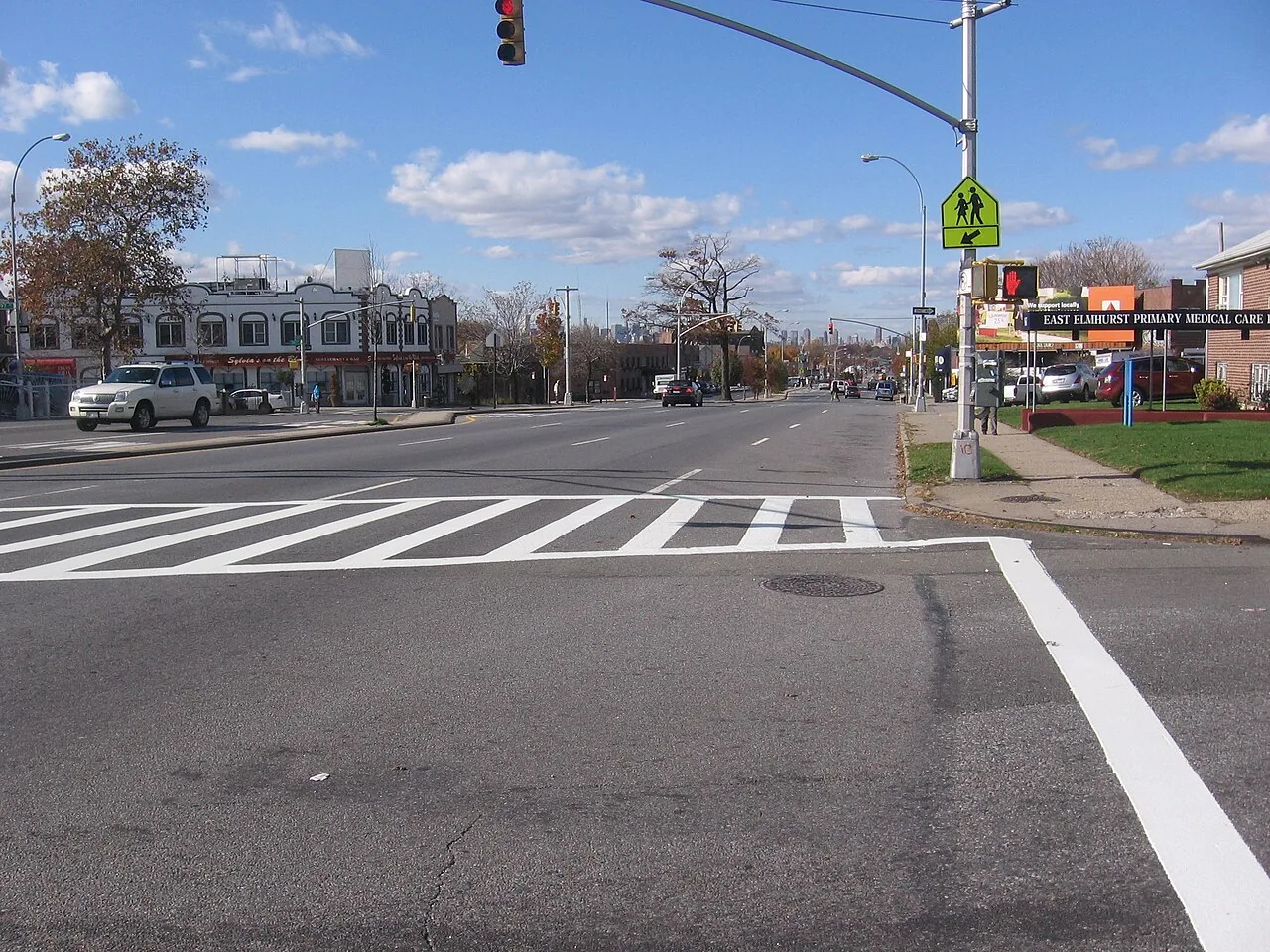
East Elmhurst
Commercial roofing in East Elmhurst, Queens, NY: converted office and industrial roofs near LaGuardia, Ditmars and Northern Boulevard shop roofs, drain repair.

Springfield Gardens
Commercial roof repair, coating and replacement in Springfield Gardens, Queens, NY, near JFK and along Merrick, Rockaway and Guy R. Brewer Boulevards.
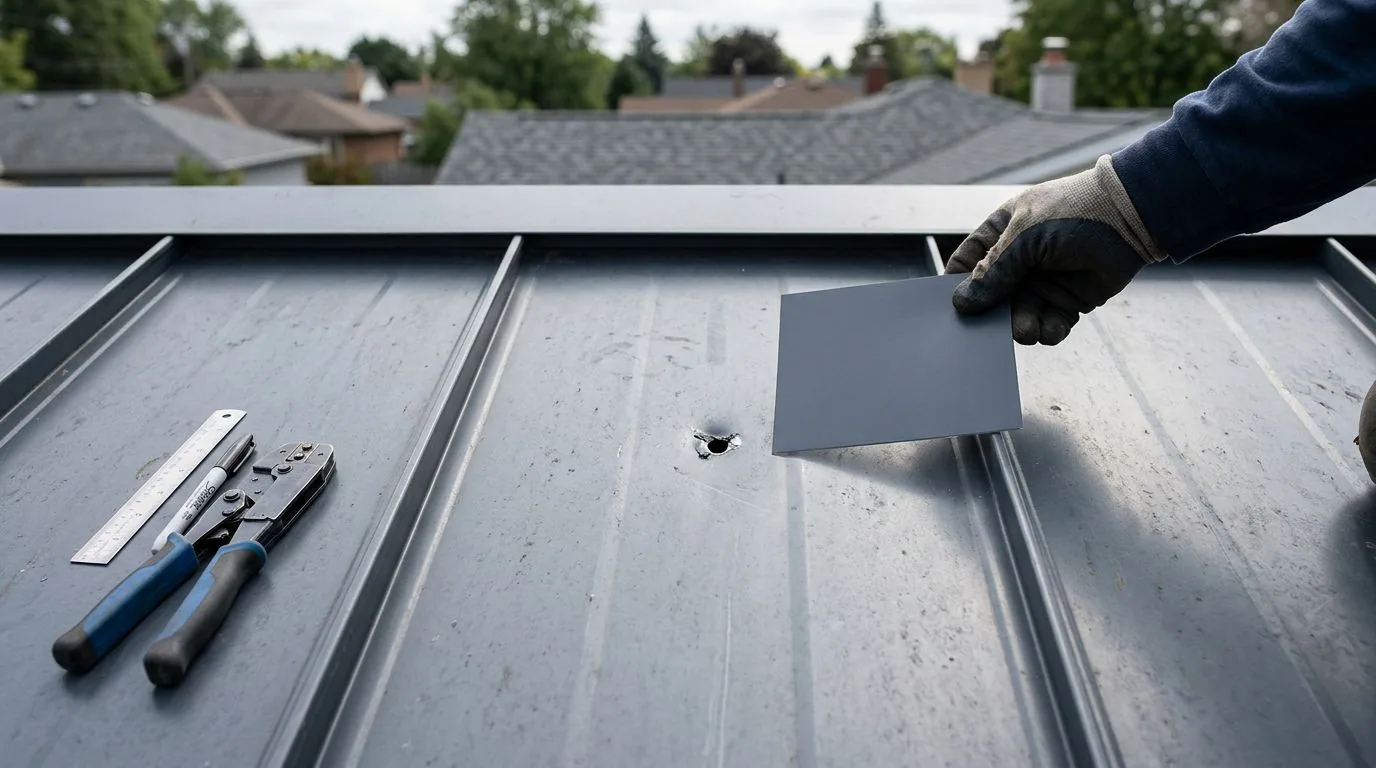
Standing Seam Metal Roofing
Standing seam metal roofing in Queens, NY: concealed-fastener panels for low-slope and pitched commercial roofs, with clip, seam and penetration checks.
Ready to Talk About Aircraft Hangar Roofing?
Tell us about the building and what you are seeing. We will schedule a roof walk and send photos and a written scope.