
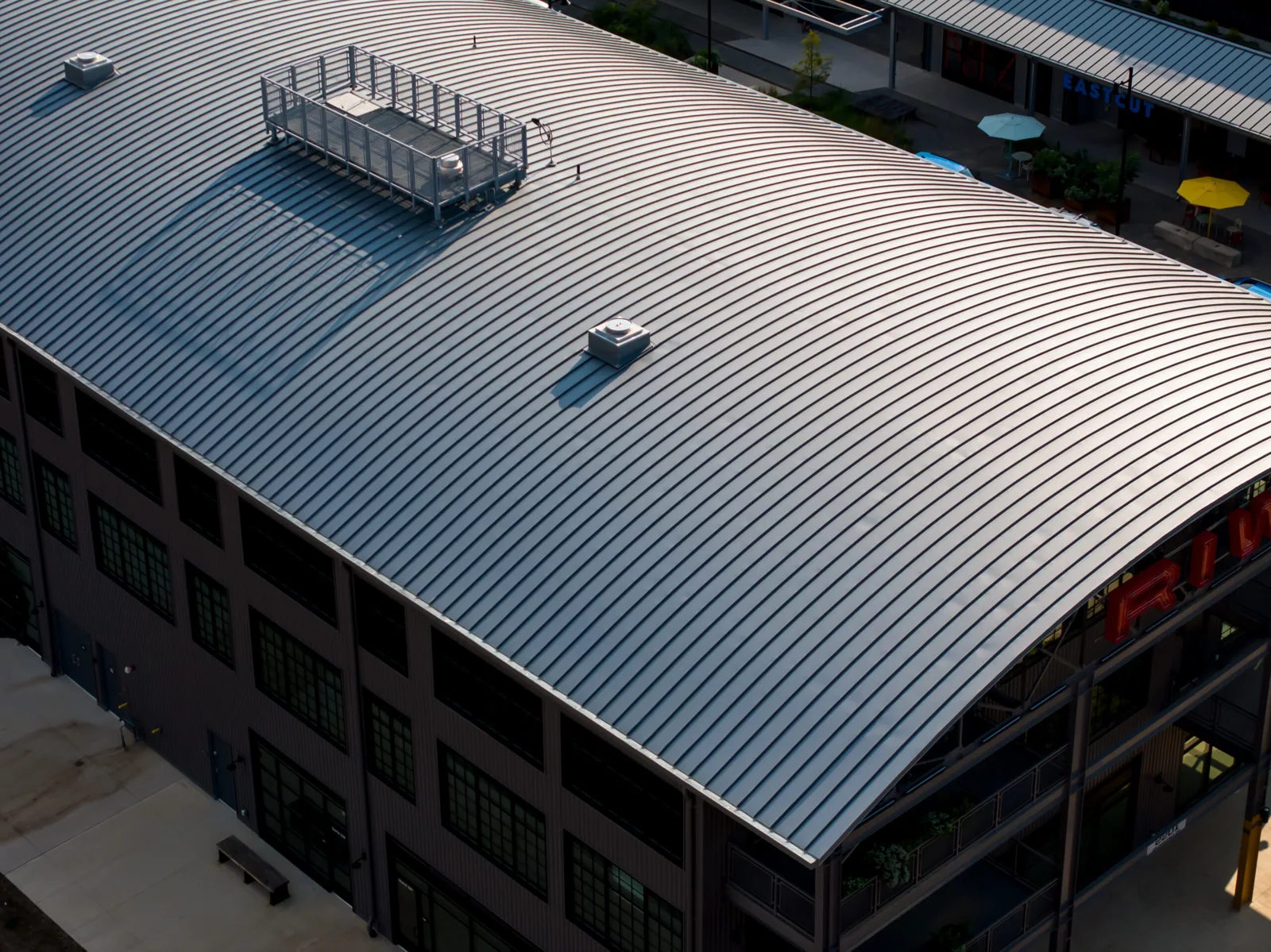
Brown streaks that run down a metal roof from every screw head are the plainest warning a roof can give. Each streak marks a fastener whose washer has hardened, whose hole has widened or whose head has begun to rust, and each is a path for water into the building below. An exposed-fastener metal roof depends on hundreds or thousands of small rubber seals, and those seals age faster than the panels. The question is not whether the screws need attention, but how much of the roof has reached that point.
What is an exposed-fastener metal roof?
It is a roof of corrugated or ribbed metal panels that are screwed through the face of the panel into the purlins or deck below. Each screw carries a neoprene or rubber washer that seals the hole. The panels lap at the sides, and sealant or a closure strip fills the lap. Such roofs are common on sheds, warehouses, light industrial buildings and older additions.
They are also simple and cheap to build, and that is their weakness. Heat and cold work the panels, the screws loosen, the washers dry and crack and the laps open. The metal itself can last for decades, while the fasteners and seals run out in far less time.
How do we check one?
Walk it with me. First we look at the screws: backed-out heads, stripped holes, rust and cracked washers. Second we look at the laps and the ridge, where sealant fails and panels separate. Third we check the metal for rust through, especially at the low edges, in valleys and around penetrations. Fourth we look inside, at the underside of the panels and the insulation, for staining, condensation and wet spots.
That inside look matters. Condensation can look like a leak, and a leak can look like condensation. Rust on the underside, water stains on the insulation and dripping at the same spot in dry weather all point to different causes. The commercial roof inspection sorts them out before we propose repairs.
Water finds the lowest path on a ribbed roof, and the valley between ribs becomes a channel. A leak at a lap may show up forty feet downslope at a skylight or a cut panel. We follow the channel with water from a hose, one section at a time, until the stain at the ceiling responds, and we mark each entry point on the roof.
What does restoration involve?
Restoration keeps the existing panels and renews the parts that fail. The steps are in order. We clean the roof and remove loose rust. We replace or re-seat each failed fastener with an oversized screw and a new washer. We reseal the laps, ridge and penetrations with a compatible sealant or tape. Then we apply a coating that bonds to the metal and bridges the small gaps, such as a silicone coating or an acrylic coating.
That sequence works when the metal is sound and the insulation is dry. A coating cannot fix a panel that has rusted through or a roof that is leaking at the structure. A short test patch on a clean area shows whether the coating will bond before we commit to the whole roof.
Cost follows the number of fasteners, the length of the laps and the amount of rust to treat. A roof with many thousands of screws takes days of labor even before the coating goes on, and access matters: a low shed is quick, while a high bay with no ground-level reach needs a lift. Weather decides the schedule, since sealants and coatings need dry surfaces and mild temperatures to cure.
When do we retrofit instead?
A retrofit covers the old roof with a new one. For a metal roof, that usually means fastening new framing or sub-purlins over the old panels and installing a new panel system, often a concealed-fastener one, on top. The old roof stays in place as a base, so the building stays dry during the work and the tear-off is avoided.
Retrofit makes sense when the panels are sound enough to carry the new load but the fasteners and laps are past saving. It adds weight, so the structure is checked first. It can also add a layer of insulation between the old and new roofs. A standing seam metal roof over old corrugated panels is a common outcome, and the choice depends on slope and budget.
Weather is why the choice matters. January 23, 2016 put 27.3 inches of snow on the city in one day, and the meltwater runs straight into open laps. Hurricane Ida's remnants on September 1, 2021 brought a flash flood emergency, a first for New York City, with the largest share of deaths in Queens. A roof with loose fasteners leaks first in storms like those, so a retrofit that closes them is a step toward a dry building.
Where do these roofs turn up in Queens?
Look first at industrial and warehouse districts. South Ozone Park lies just north of John F. Kennedy International Airport, between Aqueduct Racetrack and the Van Wyck Expressway. College Point's southern end holds oil storage, a cement plant, furniture warehouses and contractors. New Hyde Park has warehouses near its Long Island Rail Road station. Where a metal shed or warehouse addition stands in a district like these, the roof may well be an exposed-fastener one, and a walk will tell.
The Lalance and Grosjean factory in Ozone Park closed in the 1960s, became a city landmark in 1981 and now serves as a medical clinic, a reminder that buildings here outlive their first purpose. A flex industrial roof that has changed tenants over the years is a typical retrofit candidate, and on a building in South Ozone Park the screws are the first thing to try.
What is the next step?
Send photos of the screw heads, the laps and any rust, with a shot of the ceiling or insulation below. Heat and condensation both act on a metal panel, so tell us what the building does underneath. A walk of the roof comes first, and it settles whether restoration or retrofit suits the building before cost is discussed.
Questions Owners Ask
What building owners and managers usually ask before a roof visit.
Often, as a first step. Larger screws with new washers fix loose holes, but laps, ridge and penetrations also need sealing. If the metal is rusting through, fasteners alone will not hold. A pull test on a sample of screws shows how many are failing.
Surface rust brushes off and leaves sound metal. Structural rust leaves flakes, holes or thin edges. We tap, scrape and inspect from below. Where the metal is thin, restoration is poor value. Photos of the underside help most.
It stops the small ones if the metal is sound and the laps are sealed. A coating does not bridge large gaps or rotted panels. We test a patch and compare the cost with a retrofit. Annual cleaning keeps the coating bright and shows where it is wearing.
It may. A new roof assembly falls under Chapter 15 of the NYC Building Code, and the owner's design team decides which filings apply. We coordinate with them.
Send photos of the screws, the laps, any rust and the ceiling below, along with the roof's age and use.
Related Roofing Work
Other pages that connect to Metal Roof Retrofit and Restoration.
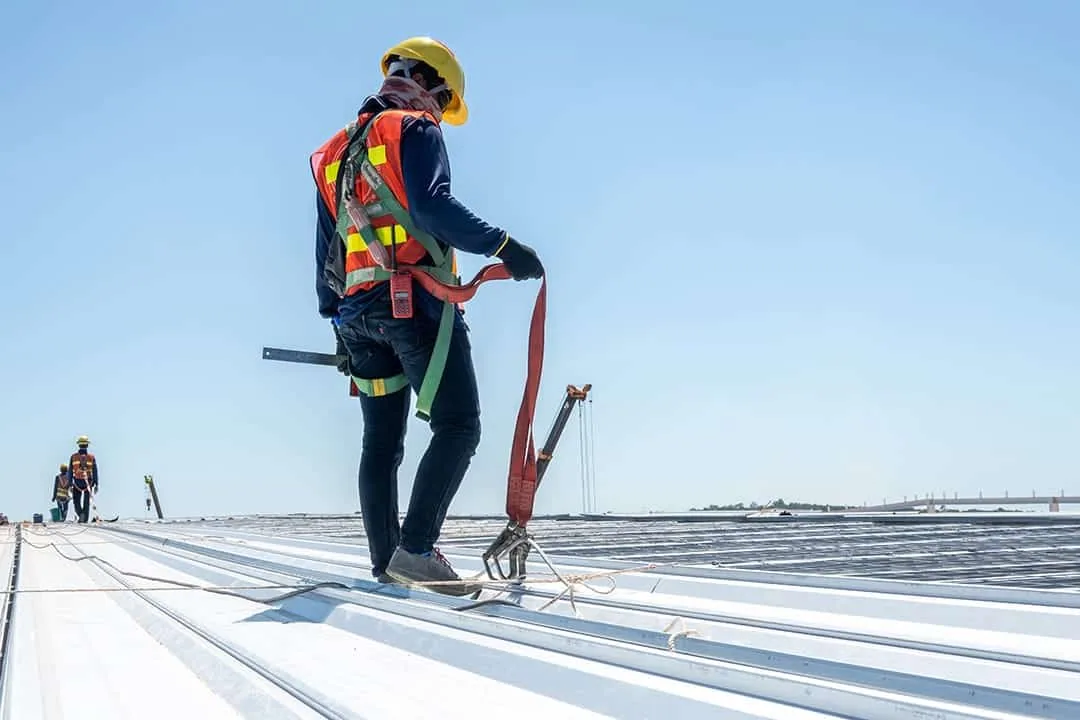
Commercial Roof Inspections
Hands-on commercial roof inspections in Queens, NY, with written findings, photographs and a ranked list of what to fix now and what can wait.
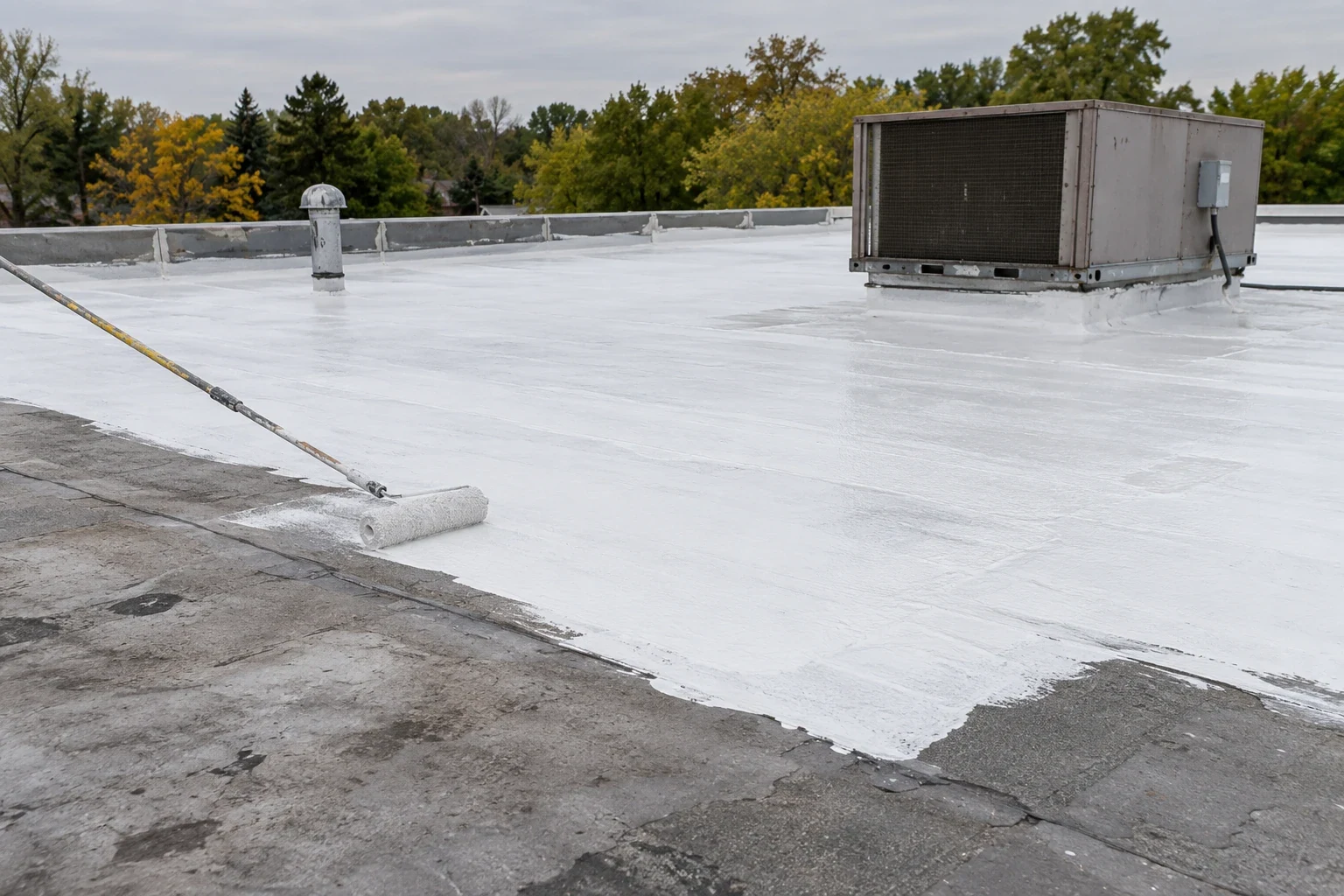
Silicone Roof Coatings
Silicone roof coatings in Queens, NY: liquid-applied reflective coatings for flat roofs that hold water, with testing, prep and recoat timing explained.
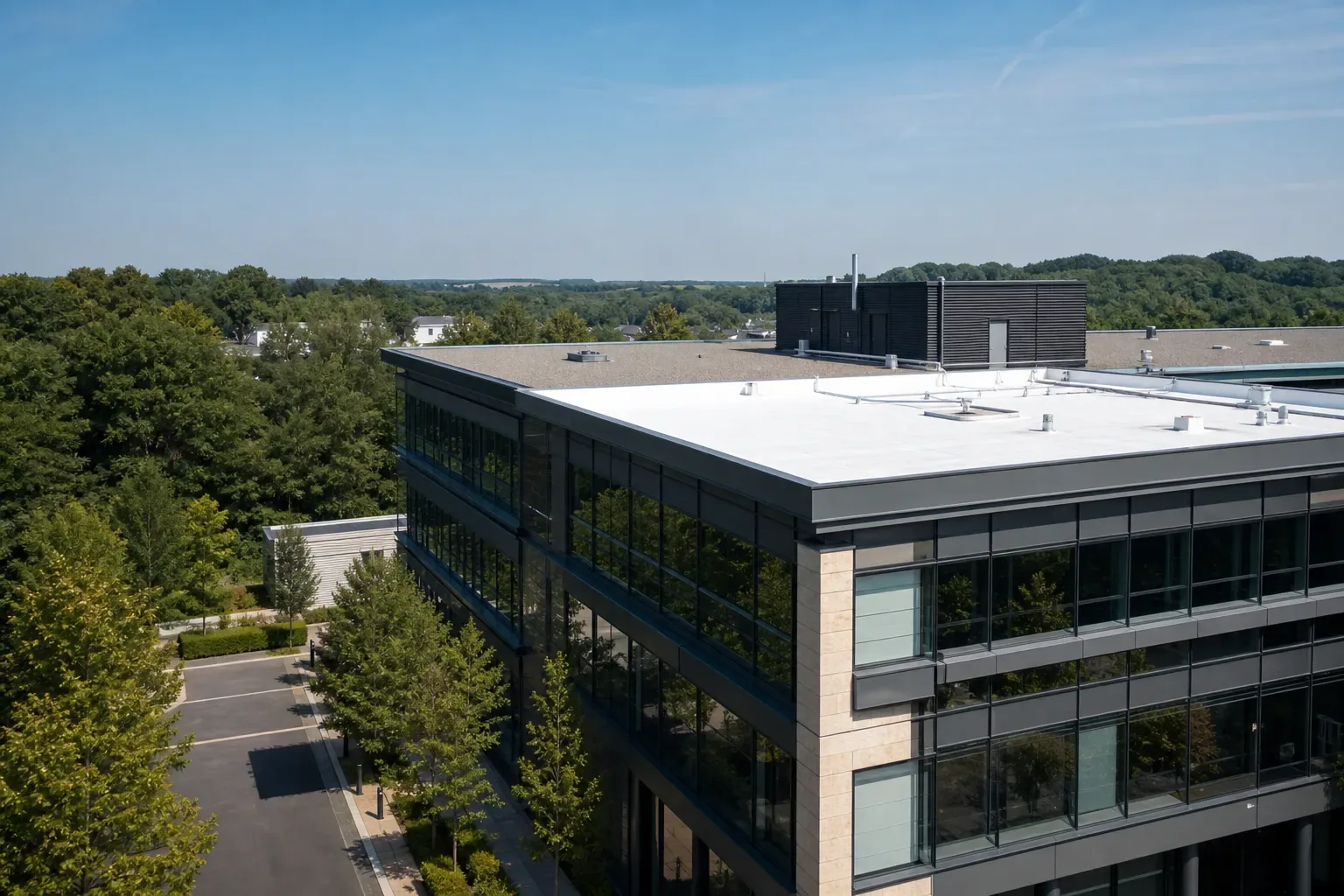
Acrylic Roof Coatings
Acrylic roof coatings in Queens, NY: water-based reflective coatings for dry, sound flat roofs, with weather windows, prep and recoat timing explained.
Ready to Talk About Metal Roof Retrofit and Restoration?
Tell us about the building and what you are seeing. We will schedule a roof walk and send photos and a written scope.