
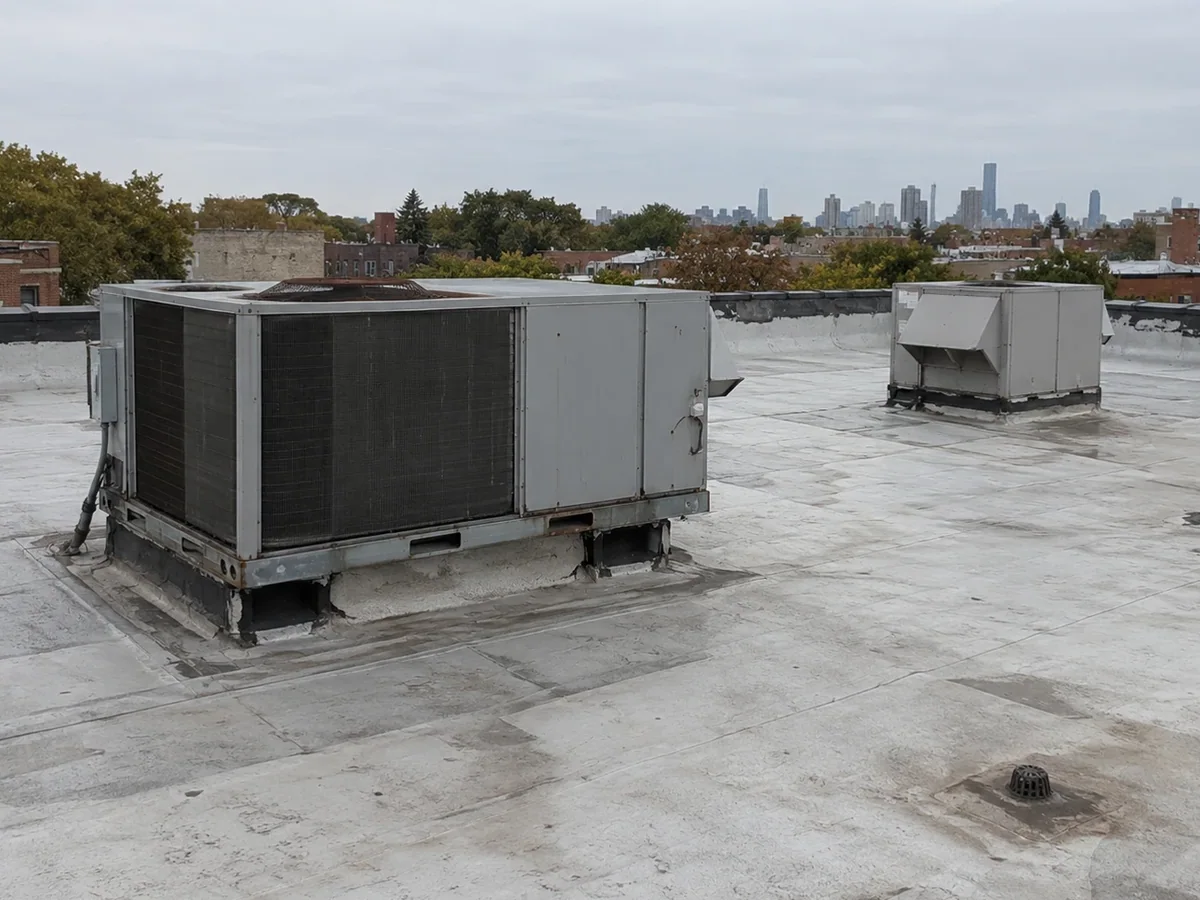
A drip that lands on the same treadmill every Monday morning, wet weather or dry, is usually not the roof at all. Showers, a pool hall and a crowded studio put a great deal of water vapor into the air of a fitness building, and when that air reaches a cold deck it condenses and falls looking exactly like a leak. Sorting condensation from a true opening is the first job. Our commercial roof repair and replacement in Queens, NY reaches gyms and recreation centers too, and there the work starts with that question and moves back one step at a time.
Follow along with me from the stained tile up to the deck.
What does the manager see, and which cause does it suggest?
Rain-linked rings point to a roof leak. A ring that shows on cold mornings and after busy classes points to condensation. A drip beside a rooftop unit on a dry day points to condensate from the unit, and a wet carpet along a wall points to failed flashing at the parapet. Each calls for a different repair, and treating the wrong one wastes money.
The manager's best tool is a log of the date, the weather and the hour of every drip, with a photograph. Held up against the class schedule and the forecast, it usually sorts the causes within a week. If the log leaves doubt, readings from a moisture meter and a look from beneath the deck will end it.
The deck's underside gives the last clue: rust blooms, wet insulation and rows of condensation drops all point away from an opening in the roof, while a dry underside under a growing stain puts the entry above.
What is happening in the roof assembly?
A fitness roof carries heavy air handlers, locker room exhaust and makeup air for the studios, each on a curb that must stay flashed and tight. Humid air rises to the underside of the deck, and in winter, when the deck is cold, it condenses on contact with the metal. Steel rusts, insulation soaks, and drops fall into the room.
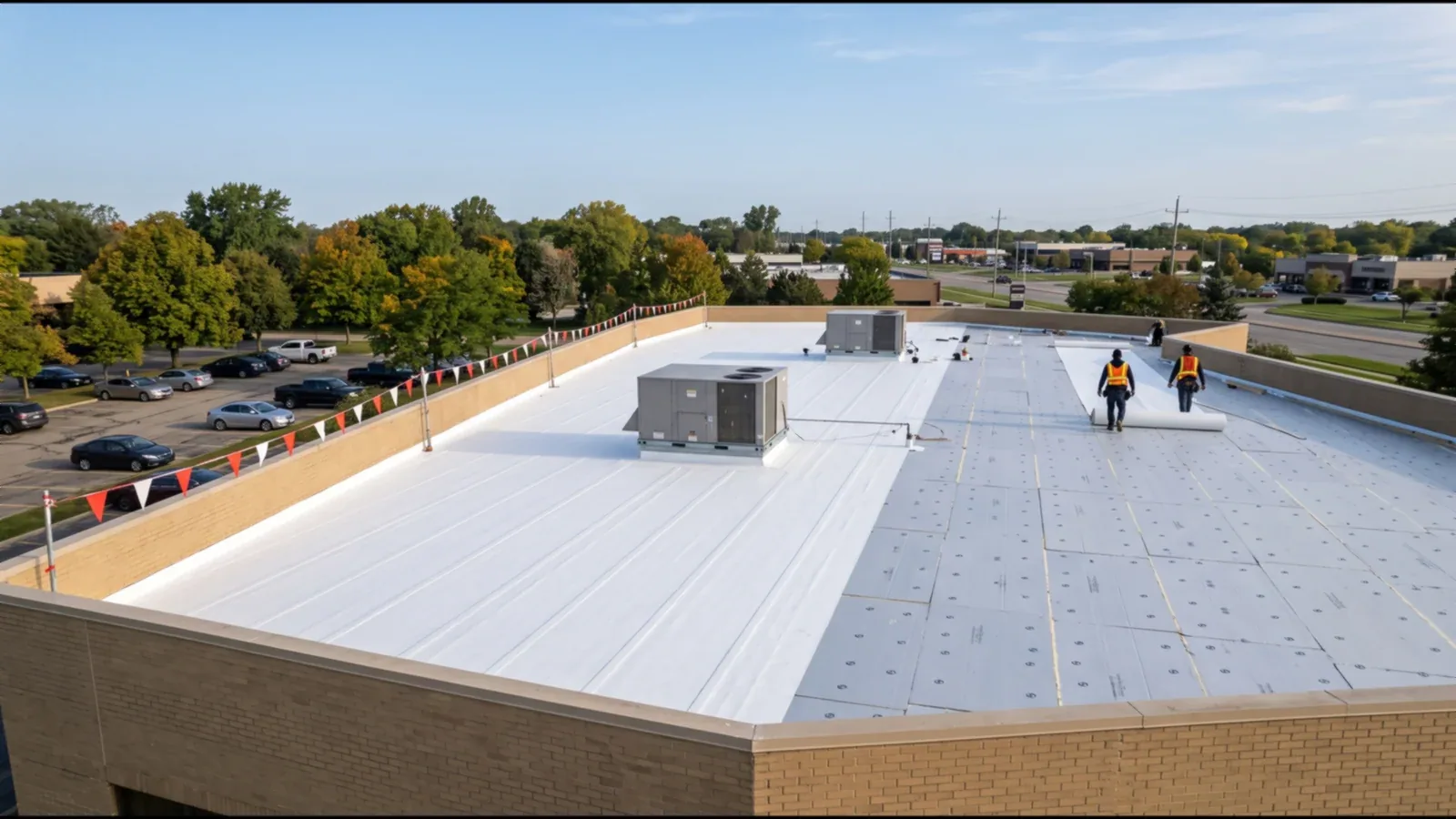
The curb at each heavy unit is the first check, because vibration tires the sealant. Then come the drain strainers, because a wide flat roof depends on a few outlets, followed by the seams and the parapet flashing. Insulation that is wet from below will not be helped by a surface patch; the route the humid air takes has to be changed. The insulation and cover board layers set how well the roof resists both heat and moisture.
Parapets finish the list. A cracked coping joint can feed a wall behind a locker room, where water sits for a long time before it stains anything, so we read the coping joints and counterflashing along every wall that borders conditioned space.
What can Queens retail buildings teach about fitness roofs?
A fitness operator may lease space in a building it does not control, and Queens offers a wide range. Metro Mall in Middle Village is a three-story mall built in 1972 to 1974. Rego Center Phase II holds 950,000 square feet of retail on 62nd Drive with a 312-unit residential tower built on top, and Queens Center in Elmhurst has about 1,000,000 square feet of gross leasable area. In Woodside, a former trolley car barn became the Tower Square Shopping Center.
A tenant under any such roof needs to know who owns it, who pays for it and whom to call, so the roof plan we draw names the area above the premises. Operators around Middle Village, Rego Park or Woodside can begin there.
A podium deck needs its own note. When a roof doubles as a terrace under a tower, pavers, planters or walkways cover the membrane, and water beneath them cannot be seen, so we lift a few units to read the membrane below and file the photographs.
How are heavy rooftop units kept from damaging the roof?
A unit that runs long hours sends constant vibration into its curb. If the deck under the curb has sagged or rusted, the unit leans and the flashing splits, so we probe the deck around every heavy curb, note any movement and check the cap, fasteners and sealant line.
When a unit is replaced, the curb should be sized for the new equipment rather than the old. A rebuilt curb with proper flashing costs little next to a membrane torn up by a badly set unit, and the right rooftop equipment curbs and supports account for the load path under the unit as well as the flashing above it.
If ventilation is being upgraded in the same season, plan it with the roof. Any new exhaust fan needs a curb flashed properly, and the framing underneath should be confirmed before the unit is set.
What do cloudbursts, snow and heat do to a gym roof?
Ida's remnants arrived on September 1, 2021 and set off the city's first flash flood emergency, with the most deaths in Queens. In a cloudburst of that size, an outlet that copes with ordinary rain can overflow. A typical year brings roughly 30 inches of snow, and 27.3 inches came down on a single January day in 2016, when ice in a drain bowl would have dammed the water behind it.
Summer is the other test. Central Park averages near 85 degrees on a July afternoon, the heat island keeps the warmth, and LaGuardia once recorded 107 F. A fitness building already fights heat generated inside, and a dark roof adds to it, and a light, reflective surface takes some of that cooling work off the plant, provided the roof beneath is dry and sound.
What is the next step for a fitness operator?
The next step is a walk and a written plan. Members will not wait weeks for a gym to reopen, so the schedule carries weight. Loud tear-off goes into the first hours of the day or onto slow days, the operator signs off on every equipment shutdown, and protection goes up over the floor beneath the work. The same habits serve a school gym roof and a shopping center roof, where the building stays open throughout.
Price tracks access, curb count and how long equipment must stay off. In winter the work is mostly repair and dry-in, with drains opened before the first freeze because ice can crack a drain's clamping ring.
Questions Owners Ask
What building owners and managers usually ask before a roof visit.
Set the drip beside the forecast and the class schedule. Rain and snowmelt bring roof leaks; cold mornings and packed, steamy hours bring condensation. A moisture meter on the roof and a check under the deck tell them apart.
Usually not. The roof is done a zone at a time, the floor beneath the active zone is covered, and loud stages are held to early mornings or quiet days, with every equipment shutdown agreed in writing with the operator.
Not usually. Roof, deck and budget choose the membrane. Over a humid space the vapor path and ventilation weigh more than the sheet, and they are settled before anything is ordered.
The owner keeps the master file, and the tenant keeps a copy with the roof plan marked above its premises. That makes it clear who calls whom when water appears.
Photos of the ceiling stain and the nearest rooftop unit or drain, with the address, are enough. From those we can say in plain steps whether the ring is rain or humidity.
Related Roofing Work
Other pages that connect to Fitness Center Roofing.
Roof Insulation and Cover Board
Roof insulation, tapered systems and cover board for commercial roofs in Queens, NY: wet insulation, slope, thermal value and what goes under the membrane.

Middle Village
Commercial roof repair and replacement in Middle Village, Queens, NY: Metropolitan Avenue retail, repurposed big-box space and warehouse-style roofs.
Rego Park
Commercial roofing in Rego Park, Queens, NY: single-story shop roofs on 63rd Drive, large retail center roofs and stacked roofs under towers, with drain repair.
Ready to Talk About Fitness Center Roofing?
Tell us about the building and what you are seeing. We will schedule a roof walk and send photos and a written scope.