
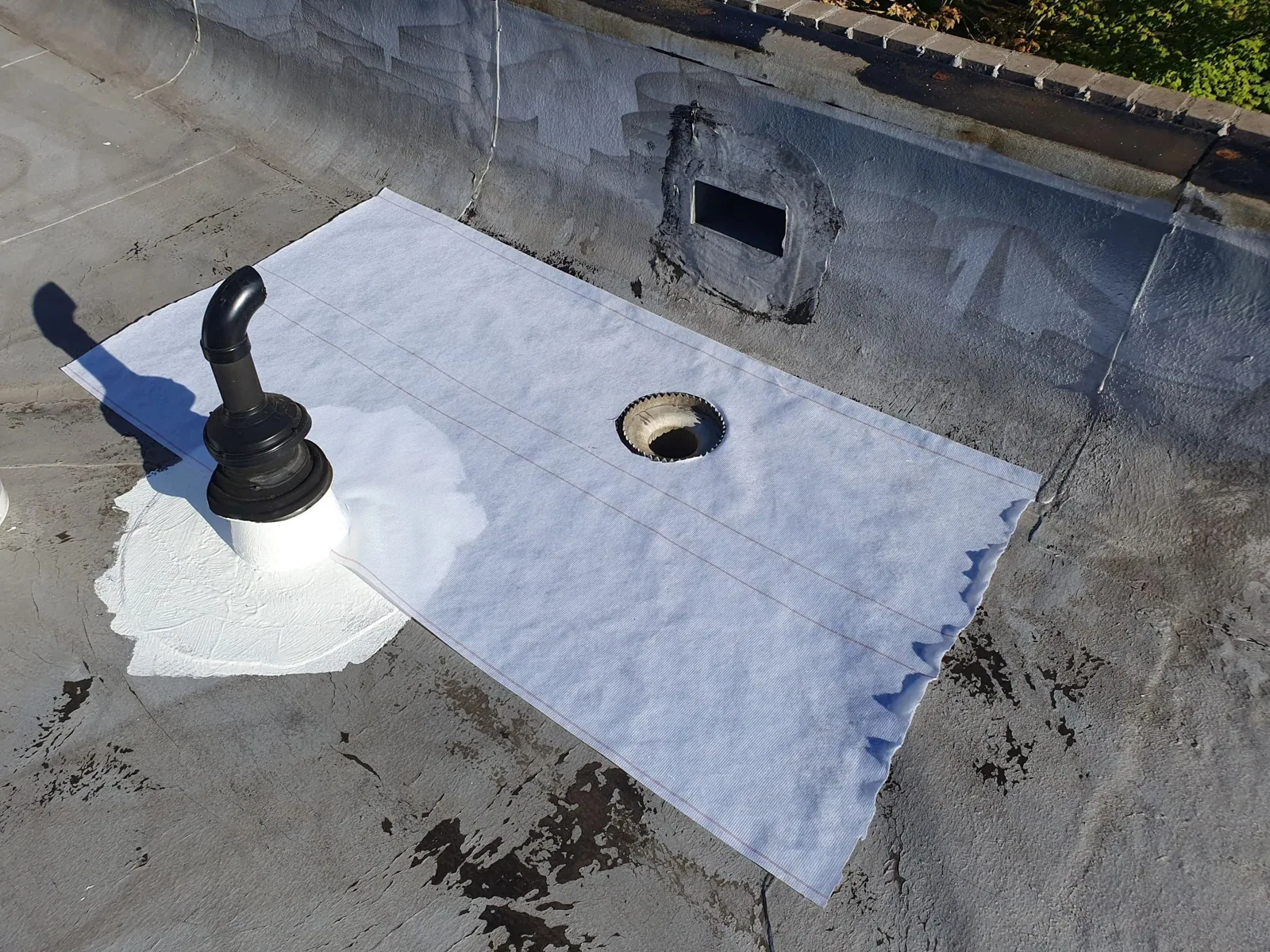
A pale ring of dried grit on a flat roof marks the edge of a pond that stood there after the last storm. Owners who find that ring usually find a second one a few feet inside it, and a third inside that, each one a record of a smaller pond that stood a little longer. The rings tell us how much water the roof is holding and how slowly it leaves.
Drains, scuppers and crickets are the parts of a flat roof that decide whether water leaves or stays. When they work, nobody thinks about them. When they do not, every other part of the roof is asked to resist standing water for which it was never designed. Our work on Queens, NY roofs starts at the outlet and moves outward, because the cause of a pond is nearly always closer to the drain than the stain suggests.
What are the parts, and what does each one do?
A roof drain is an opening in the low point of the roof, with a body set into the deck, a clamping ring that grips the membrane, and a strainer on top that keeps debris out of the pipe. A scupper is an opening through the parapet wall that lets water flow out to a downspout or the open air. A cricket is a small peaked section built behind a curb or rooftop unit to push water around it instead of letting it collect. Tapered insulation does the same job across a whole roof, giving the surface a slope toward the outlets.
Each part fails in its own way. Strainers clog. Clamping rings loosen and let water under the membrane. Scuppers set too high hold an inch or two of water permanently. Crickets are missing where a unit was added later. We examine each and write down which one is the cause, so the owner pays for the right fix.
Why do cloudbursts expose drainage problems so fast?
A drain moves only so much water at a time. When rain falls faster than that, the roof stores the excess as a shallow pond until the drain catches up, and a roof with a clogged strainer never catches up. Ida's remnants, on September 1, 2021, led the city to declare its first flash flood emergency, and Queens had the largest share of the deaths. Rain at that rate asks every outlet on a roof to work at the same moment.
This is why we check for secondary drainage, such as overflow scuppers set slightly above the drain level. If a primary drain fails, the overflow lets water escape before it rises to the top of the parapet. A roof with no overflow depends on a single path staying clear. Sandy left six feet of water in Maspeth in 2012, and a low-lying property has enough to deal with at street level without its roof adding to the problem. The same checks apply to storm damage roof repair after a heavy rain.
How do I tell if my roof is ponding?
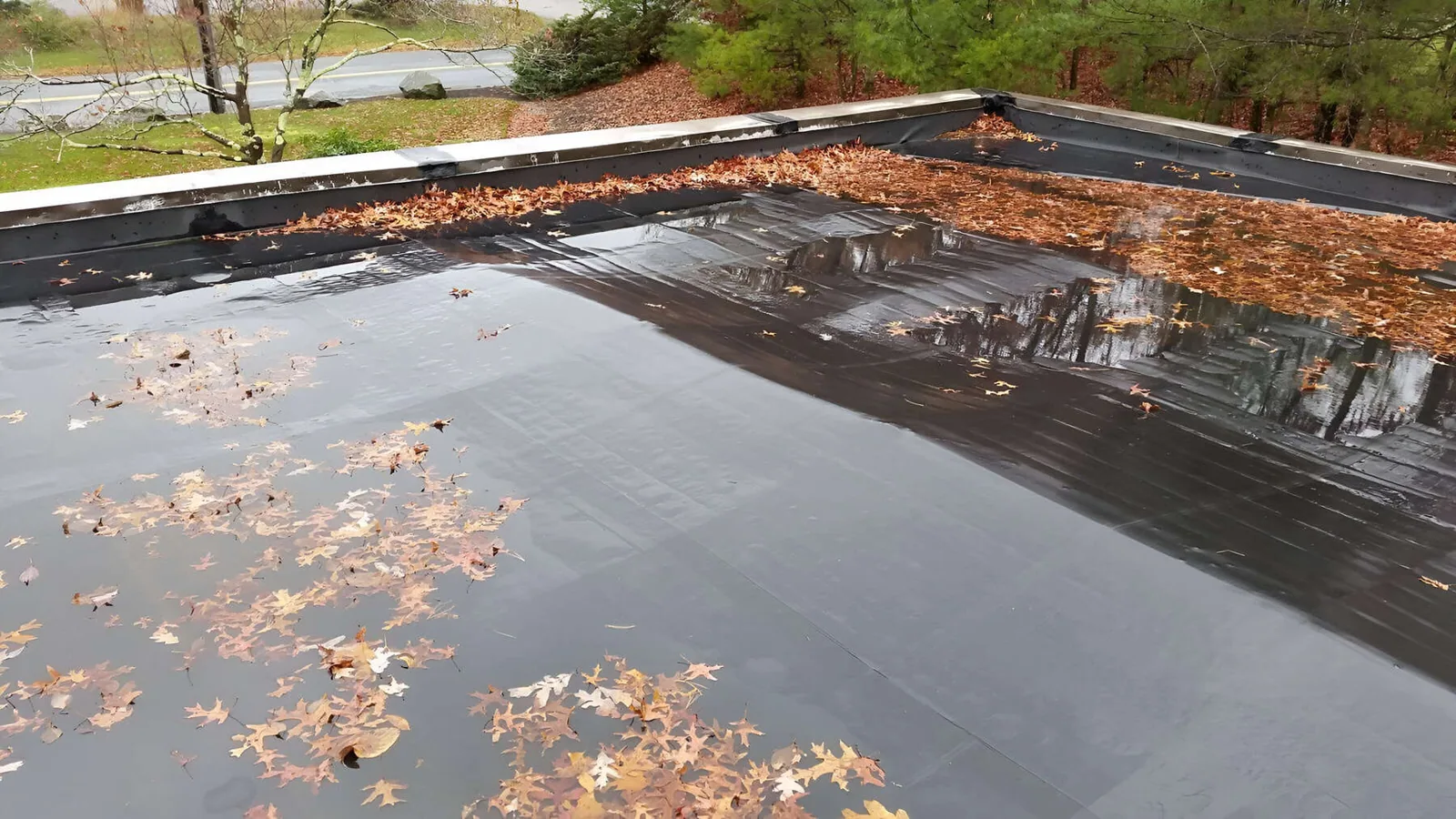
Water that is still on the roof 48 hours after rain has stopped is ponding. Other signs are staining in rings, algae growth, dirt lines and a membrane that is shiny in some areas and dull in others. Sometimes the first sign is underneath: a ceiling stain that appears days after rain, from water that sat above it and found a pinhole. Long-term ponding adds weight, breaks down the surface and speeds up seam failure. A section of ponding on a flat roof is covered by ponding water roof repair, and the correction depends on why it formed.
If the deck has sagged, the pond sits in a low spot far from a drain, and the cure may be tapered insulation or a new drain at the low point. If the drain is high, the cure is a reset or a sump. If the roof is flat and drains are far apart, a cricket or a tapered system brings the water to them. We find the cause by measuring, using a level or a laser and marking the low points before any material is ordered.
What are the repair options?
The cheapest fix is cleaning: clearing strainers, flushing lines and removing debris. Next is adjusting the outlet, by resetting a drain body, adding a sump or lowering a scupper. Then comes changing the slope, with tapered insulation or insulation and cover board laid to falls, which solves the pond across a whole area. For a scupper, we often add a sleeve or a sealed liner and a drip edge so water clears the wall below, and edge metal and gutters are checked in the same visit.
Drain lines below the roof belong to a plumber, and we coordinate with one when a line is blocked or undersized. Questions about sizing and overflow requirements sit with the building's engineer and the applicable code, such as the roof assemblies chapter of the NYC Building Code. We supply measurements and photographs for that review.
Which Queens buildings should look at this first?
Wide flat roofs show ponding first, because water has a long way to travel to the nearest outlet. Around the Degnon Terminal next to the 192-acre Sunnyside Yard, and at the 950,000 square feet of retail in Rego Center Phase II on 62nd Drive, drain spacing and slope are the questions we put first on any low-slope roof we inspect. In Long Island City, former factories and bakeries converted to new uses deserve a drain check whenever the use changes, since new rooftop equipment changes where water collects, and in Rego Park a retail roof with many rooftop units needs crickets behind each one.
Heat and cold both play a part. Summer heat, with July highs near 85 degrees at Central Park and a heat island on top, stretches the membrane around the drain body and loosens sealant at the clamping ring, and winter ice, in a city that averages 29.8 inches of snow, can lift whatever freezes in a sump. We re-torque rings and re-seal the drain flange as part of our spring visit, because a ring that is a quarter turn loose can let water under the membrane without any sign on the surface.
Questions Owners Ask
What building owners and managers usually ask before a roof visit.
Twice a year is the minimum, in spring and after leaf fall, plus after any storm that leaves debris. Roofs near trees or construction need more. A strainer that is more than a third covered is already slowing the drain, and we show building staff what to look for.
No. Ponding on a sound membrane can often be corrected with a drain reset, a cricket or tapered material in the low area. A membrane that has been ponded for years may have lost its surface or its seams, and we judge that on the walk before recommending anything bigger.
It is a secondary opening through the parapet, set a short distance above the roof surface, that lets water escape if the main drains clog. Whether one is required depends on the roof and the applicable code, and a design professional makes that call. We record whether one exists and whether it is clear.
Usually yes. We cut back the membrane around the drain, reset or replace the body and the clamping ring, and flash the area with new material tied into the old. The result is a sealed, sloped drain with no need to disturb the rest of the field.
Send photos of the stain, the drain and any water still standing after rain, and we will walk through what is happening on the roof in order.
Related Roofing Work
Other pages that connect to Roof Drains and Scuppers.

Storm Damage Roof Repair
Storm damage roof repair in Queens, NY: wind, flood-day rain and snow load assessed in plain steps, with temporary dry-in, permanent repair and photo records.
Ponding Water Roof Repair
Ponding water roof repair in Queens, NY: why standing water forms on flat roofs, how it ages the membrane and the drain, slope and insulation fixes that end it.
Roof Insulation and Cover Board
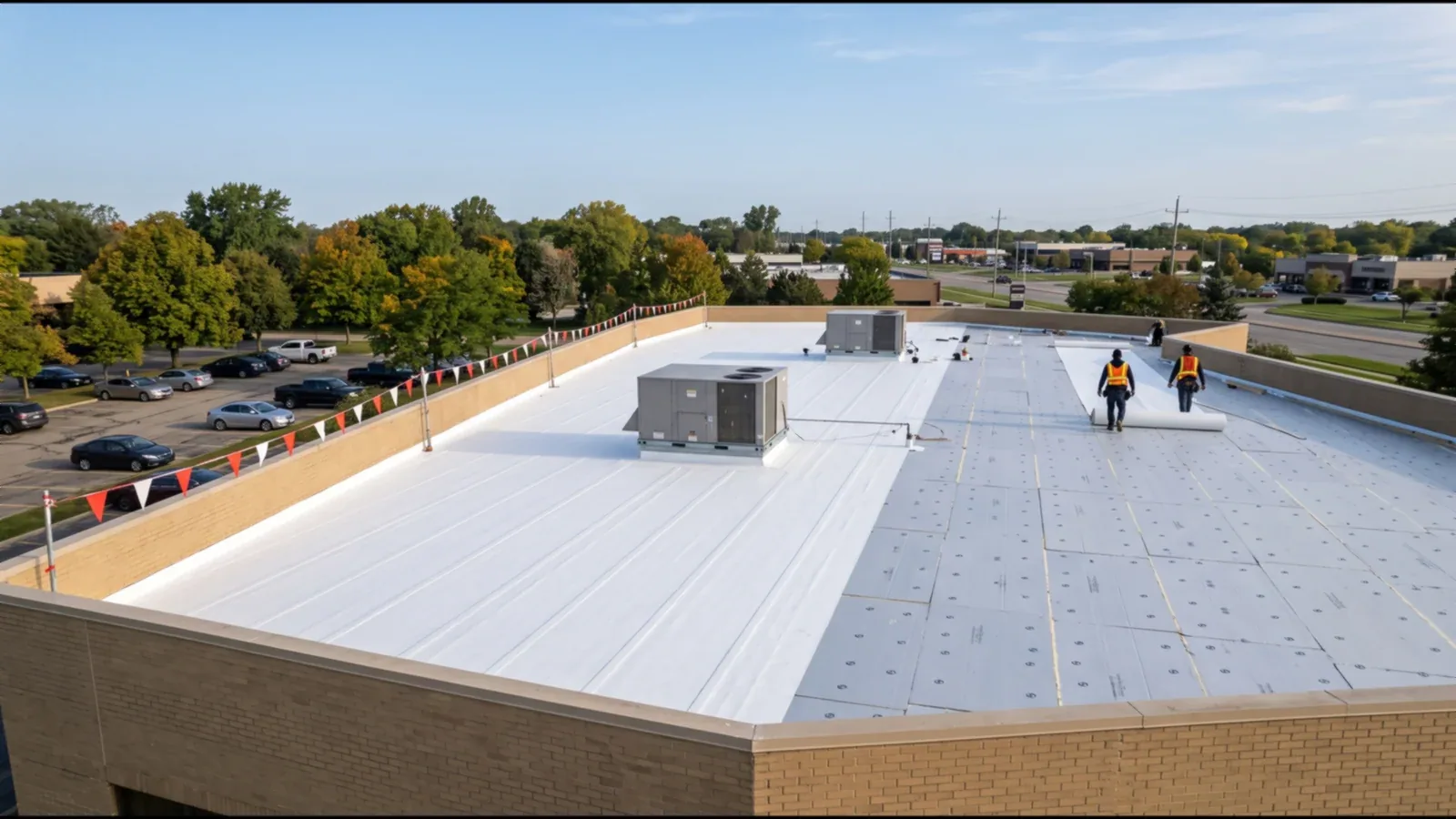
Roof insulation, tapered systems and cover board for commercial roofs in Queens, NY: wet insulation, slope, thermal value and what goes under the membrane.
Ready to Talk About Roof Drains and Scuppers?
Tell us about the building and what you are seeing. We will schedule a roof walk and send photos and a written scope.