
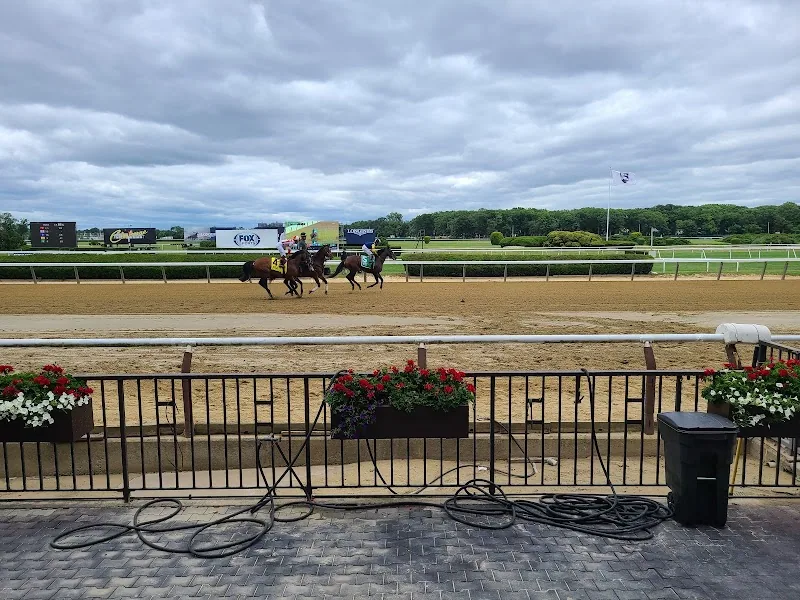
A drip on one side of a suite, and only after a storm with a hard east wind behind it, is what sends Elmont, NY owners up a ladder. The roofs behind that pattern sit along Hempstead Turnpike, the area's main business corridor, and in the shadow of the Belmont Park redevelopment, where UBS Arena and Belmont Park Village have added newer, larger buildings to an older commercial base. We repair, coat and replace flat and low-slope roofs here, and we begin by finding the path the water took.
What do the roofs along Hempstead Turnpike look like?
A main business corridor collects the buildings a community depends on: strip retail, offices, service shops, restaurants and small mixed-use blocks. What roof any one of them has is something only a walk can establish, but buildings in a corridor like this tend to share certain habits. Rooftop equipment accumulates over the years, and drains sized for the original building do not always keep pace with each addition.
Elmont sits where the Cross Island Parkway meets the Southern State Parkway, so trucks, customers and contractors all reach these buildings by the same few roads. For a roof, that means access planning matters. A hoist or a dumpster needs a place to sit, and loading hours limit when materials can arrive.
For the owner of a strip building on a busy road, the point is simple: equipment added by one tenant after another changes what the roof carries and where its water goes. A walk that lists every unit, penetration and drain gives a full inventory of what the roof now holds.
How do newer large buildings change the picture?
UBS Arena, the Islanders' home, opened in fall 2021 as part of the Belmont Park redevelopment, and Belmont Park Village, an open-air luxury outlet center, opened in October 2024. Both are recent, large-scale construction, and they sit alongside an older strip-commercial base.
What that mix means for an owner is a contrast in age. A roof from the last few years may need little more than a periodic walk to keep drains and flashing clear. An older roof beside it may be on its second or third membrane. We treat them differently: a maintenance program for the newer roof, and a condition report for the old one that states whether repair, coating or replacement is the wiser spend.
Where does water get in first?
Not through the middle of the roof. It gets in at penetrations, edges and drains. A rooftop unit curb with a split corner flashing, a coping joint that has opened, a plumbing vent with a cracked boot, a scupper whose lip has pulled away from the wall: each is small and each is easy to miss from the ground. We look at them in a set order, from the drains outward to the perimeter, so nothing is skipped.
Drains come first because standing water multiplies every other problem. A ponding roof holds weight, ages the membrane faster and gives any small defect a constant supply of water. Then we probe seams and read the flashing at every wall and curb.
Edges are the third stop. Where a membrane turns up a wall and meets a metal cap, the joint moves with every temperature swing, and sealant alone does not last. A reinforced termination bar, a properly lapped counterflashing and a clean substrate beneath each do more than another bead of caulk. When we find a failed edge, we show it on the roof with a photograph so the repair scope reads clearly to whoever approves the budget.
What does the weather in the New York City region ask of a roof?
Elmont is a short drive from the city line, so New York City's record is the nearest guide: about 49.5 inches of precipitation in an average year. Hurricane Ida's remnants proved on September 1, 2021 that a flat roof must shed a very large volume of water in a short time; the city declared its first flash flood emergency that day. The city averages about 29.8 inches of snow, and the 27.3 inches of January 23, 2016 loaded roofs and left meltwater refreezing at outlets.
Summer heat matters too. July afternoons at Central Park reach about 85 degrees on average under a strong heat island, and dark membranes expand and contract through that range daily. Hurricane Sandy swept hurricane-force gusts across the metro area in October 2012, a test for edge metal and coping.
How do we confirm the cause?
We start at the stain and work upward. On the roof we run a seam probe along the laps near the leak, test the nearest drain with water and look at every curb and wall. When the surface does not explain the stain, an infrared moisture survey at dusk shows wet insulation, which we mark with paint so the repair area can be sized without cutting open the roof.
The written inspection lists each finding with a photograph and a recommendation. It helps a property manager schedule work, and it records the roof's condition for an insurer or a buyer.
What are the choices, and what drives the cost?
A leak repair is enough when the failures are few and the insulation is dry. A coating restoration adds service life to a sound membrane. A full replacement fits wet insulation or an aged roof. The cost follows roof size, access, the number of penetrations, tear-off depth, edge metal and the hours tenants allow.
Any system we propose is checked against the building code that governs the property, and we confirm which one applies before the scope is written.
Occupied buildings add their own limits. A restaurant cannot lose its exhaust for a day, and an office suite with a leak above the server closet needs that corner dried in first. We sequence the work around the tenant who is most at risk, protect interiors below the work area and keep walkways clear for customers. Weather also sets the schedule: membranes and adhesives need dry surfaces, so a forecast of rain moves the tear-off, never the other way around.
What is the next step?
Photograph the stain and the nearest drain, and tell us the roof age if you know it. We will walk the roof and say in plain steps what it is doing, with price after that. Owners in nearby Valley Stream and New Hyde Park begin the same way.
Questions Owners Ask
What building owners and managers usually ask before a roof visit.
Wind-driven rain gets behind vertical details that dry weather never tests. A loose counterflashing, an open coping joint or a gap at a wall-to-roof transition lets sideways rain in. We check the upper edge of each flashing and the sealant at wall joints before looking at the field of the roof.
It needs a light touch. A walk twice a year to clear drains, check flashing and photograph the surface catches small problems while any manufacturer coverage is still in force. Debris, tenant equipment and foot traffic are the usual causes of early damage.
We document the roof as it is: photographs, a sketch and a list of every penetration. That record shows which equipment sits where and which flashing failed, so the landlord and tenants can settle responsibility on facts.
Often, if the membrane is intact enough to bond and the insulation under it is dry. We verify both with a moisture scan and an adhesion test. A coating then restores the surface and reflects heat, but it does not repair a failed flashing, so those are fixed first.
Check within a few days, before the next rain. Look for lifted edges, displaced rooftop units, blocked drains and debris on the membrane. We can take photographs and temporary-seal an opening quickly, and we answer emergency calls around the clock, including holidays.
Related Roofing Work
Other pages that connect to Elmont.
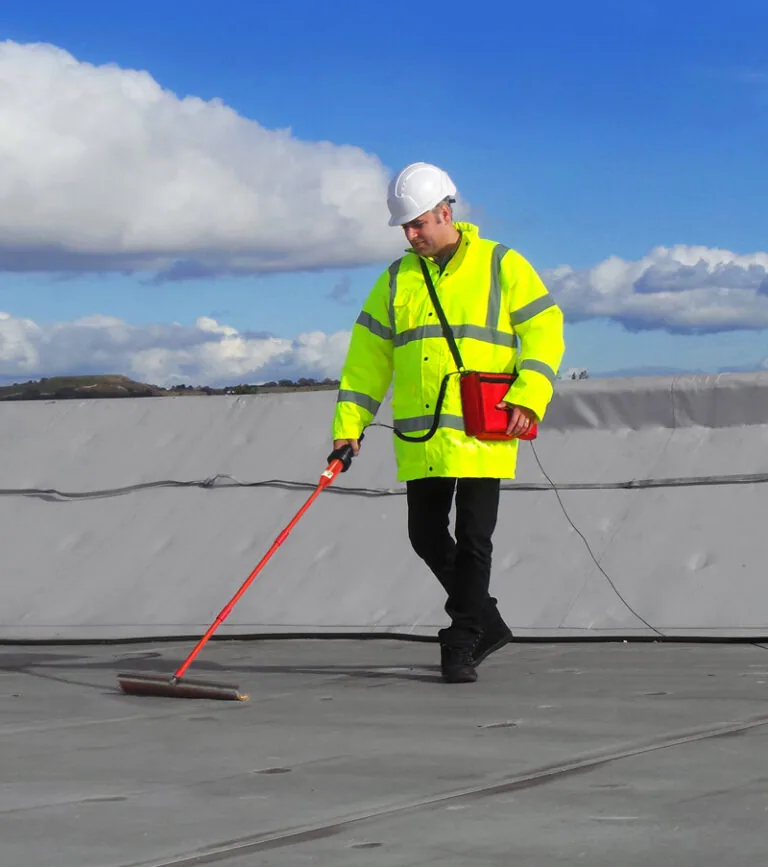
Preventive Roof Maintenance
Scheduled commercial roof maintenance in Queens, NY: seasonal drain and seam visits, flashing checks and written logs that catch small faults early.
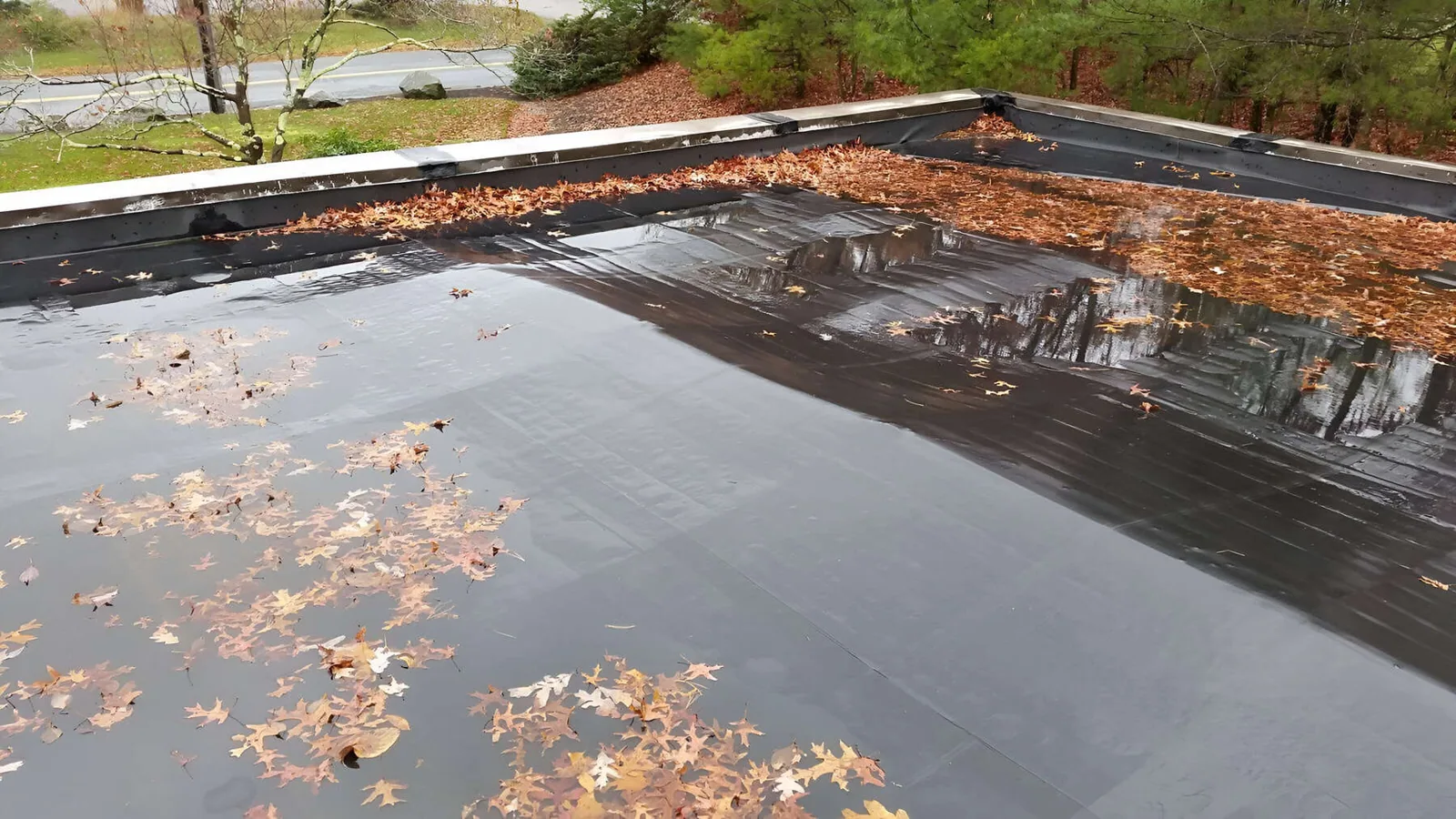
Ponding Water Roof Repair
Ponding water roof repair in Queens, NY: why standing water forms on flat roofs, how it ages the membrane and the drain, slope and insulation fixes that end it.
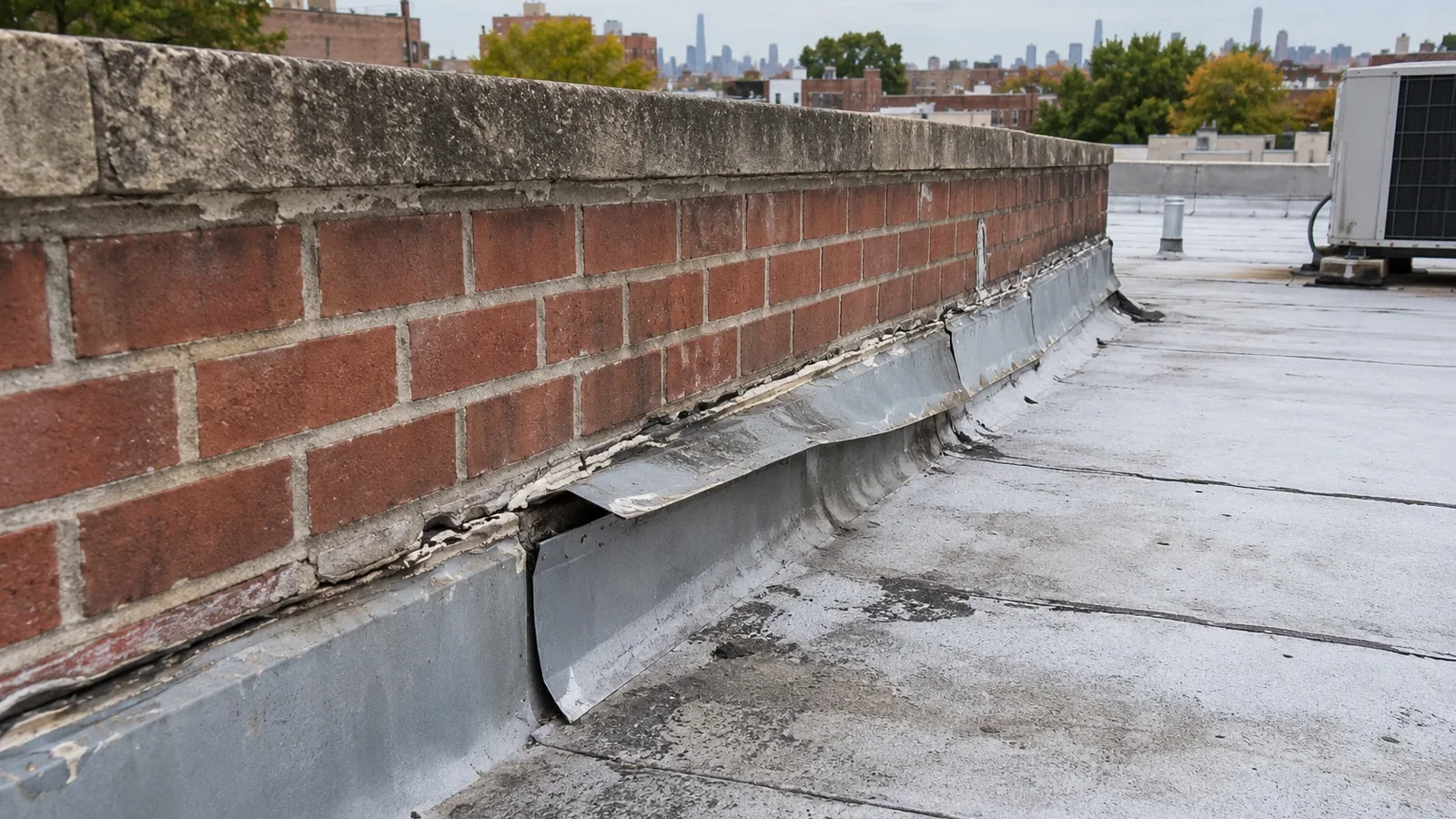
Flashing Failure Repair
Flashing failure repair in Queens, NY: cracked tar, lifted base flashing, open counterflashing and parapet leaks traced and rebuilt on commercial flat roofs.
Ready to Talk About Elmont?
Tell us about the building and what you are seeing. We will schedule a roof walk and send photos and a written scope.