
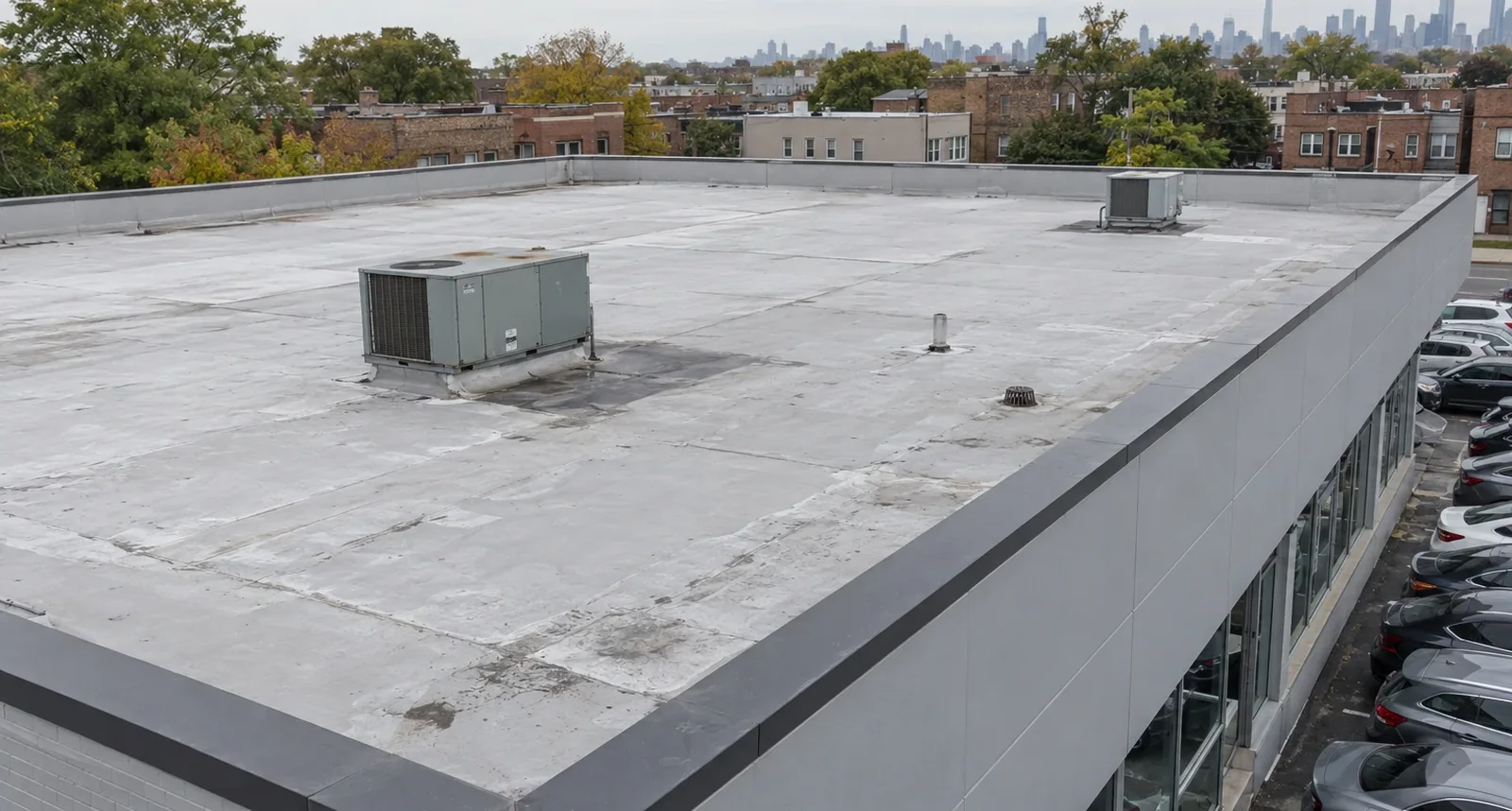
A wet corner of the showroom floor, or a drip over a customer's car in the service lane, raises one question right away: is the roof failing, or is a rooftop unit dumping condensate? From below the two look alike. A dealership puts a wide flat roof, a glass front and a crowd of rooftop equipment on one building, with costly inventory inside and under canopies outside, so a small leak carries a large bill. Repairing and replacing commercial roofs in Queens, NY means that, at a dealership, the water gets followed from the drip backward, one step at a time.
Start with me at the showroom ceiling and the cause is usually plain by the third step.
What is the dealership manager looking at?
The manager sees a wet patch on the showroom floor, a dark ring on a ceiling tile in the finance office, a puddle in the service bay or a streak down the inside of the glass wall. Each means something different. A ring that grows after rain points to the roof. A puddle under a rooftop unit on a dry day points to condensate. A streak on the glass wall points to a failed seal at the canopy or the parapet above it.
We ask for a date, the weather and a photograph for each event. After three or four entries a pattern appears, and the first roof walk becomes a test of a theory rather than a general search. The pattern also tells us whether one repair or several are involved.
Signage and lighting add penetrations of their own. A sign frame bolted through the membrane with sealant that has failed can leak for a season before anyone ties it to a stain, so each one is located on the plan and resealed where needed.
What goes wrong on a showroom and service roof?
A dealership roof divides into zones. Above the showroom there may be skylights and a tall front parapet. The service wing carries exhaust fans, makeup air units and lift equipment. A canopy over the delivery or wash area ties into the main wall. Each zone fails in its own way.
Drains and strainers come first, because a roof this wide sheds water through only a few outlets and a blocked strainer keeps water against the seams. The canopy junction is next, where a flashing has to climb the wall and be covered; a failed flashing there often passes for a wall leak in the finance office or along the showroom edge. After that we take each rooftop unit's curb in turn.
Skylights over a showroom are the other repeat offender, though the glass is seldom at fault. The curb and its flashing usually are, and water that enters above a showroom lands on vehicles within minutes. We hose-test from the low side upward to find the joint that takes it, then rebuild that flashing in one continuous run.
Service wings bring a quieter problem. Hot, damp or oily exhaust from a roof fan can soften the membrane beside it, and a film of oil collects in low spots. We note what each unit discharges and look for softening, staining or blisters in the surface around it.
How does Willets Point show what auto roofs face?
Auto junkyards and repair shops gave Willets Point its nickname, the Iron Triangle, and 225 businesses with roughly 1,400 to 1,800 employees were counted there in a 2006 Hunter College study. A redevelopment plan was approved in 2013; demolition of the industrial section started in 2016, and Etihad Park broke ground in December 2024. As of 2013 the area had no sidewalks or sewers, and heavy rain often flooded it.
For an owner of an auto building nearby, the lesson is about outlets. Water that cannot drain at street level makes a roof drain's job more important, so the checks are the same everywhere: clear the outlets, confirm the leader discharges where it should and keep an overflow path open. They apply near Willets Point, Ozone Park and South Ozone Park alike.
A big paved lot adds wind. With little shelter around it, a dealership sends the breeze straight at its roof edge, and a loose run of coping or lifted edge flashing is where a storm starts. We pull and probe the edge metal on every walk and photograph each stretch.
What records help after a storm?
An insurer reading a storm claim looks for dates on the evidence. Roof insurance claim assistance is easiest when the groundwork predates the loss: a roof plan, a condition rating and photographs of the edges and flashings in their ordinary state. After an event, a walk within the week records what changed.
With earlier photographs in the file, old wear can be told apart from new damage, and the owner and the adjuster can agree on what the storm did. Both sets are kept together and labeled by date, and a lender can read the same file when the dealership changes hands.
Edges and corners take wind first, so we pull on the metal, check the cleats and fasteners and photograph each stretch. Of the repairs that protect the most roof, edge metal and coping work is often the cheapest.
What do Queens weather and heat do to a dealership roof?
The first flash flood emergency in city history arrived with Hurricane Ida's remnants on September 1, 2021, and Queens suffered the most deaths. A drain that handles an ordinary rain can choke in a cloudburst of that kind. Summer adds its own load: a July afternoon averages near 85 degrees at Central Park, and a dark membrane over a showroom raises the cooling bill, while a reflective surface lowers roof heat when the insulation beneath is dry and sound.
The seasonal rhythm is simple. Drains and leaders are checked before the wet season, edges and flashings before winter, and sealants before the summer heat, with each visit dated and photographed.
What is the next step for a dealer?
The next step is a walk and a written rating. We clear the drains, scan and core the roof, and sort it into repair, recover and replacement. A dealership can stay open during the work, because the roof is done in zones and the showroom below the active area is protected. A shopping center roof or big-box retail roof follows the same pattern on a larger scale.
The price is driven by access, penetration count and deck condition more than by membrane choice. Exhaust fans, lift equipment and sign supports all have to be worked around, and the order of that work is spelled out in the scope.
Questions Owners Ask
What building owners and managers usually ask before a roof visit.
A roof leak follows rain and grows after storms, while condensate shows up under the unit on a hot, humid day, even without rain. A moisture scan and a look at the unit's drain line settle which one you have.
Yes. The service wing goes first, each shift ends dry, the interior beneath the active area is protected and the showroom entrance stays clear. Noisy work can run early in the morning or after closing.
A flashing that climbs the wall, a counterflashing that covers it, and sealant that can move as the temperature changes. We probe it by hand and test it with a hose from the low side.
White cuts the heat that collects above a showroom in July and takes some load off the air conditioning, but only a sound, dry roof gets the full benefit, so the scan comes before the color choice.
Photos of the wet spot and the nearest drain, plus the address, are enough to begin. We will take you through what the roof is doing, a step at a time.
Related Roofing Work
Other pages that connect to Auto Dealership Roofing.
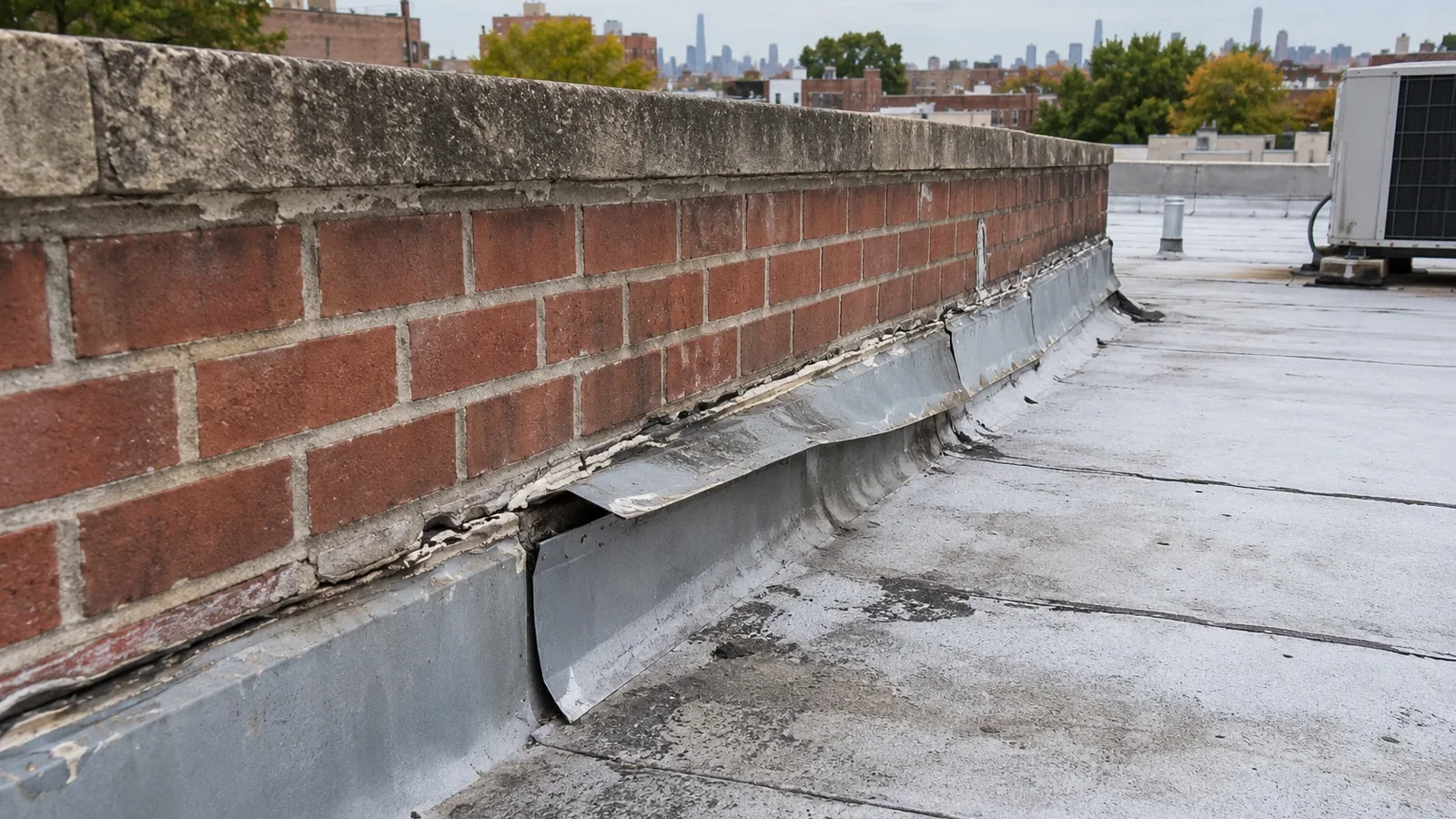
Flashing Failure Repair
Flashing failure repair in Queens, NY: cracked tar, lifted base flashing, open counterflashing and parapet leaks traced and rebuilt on commercial flat roofs.
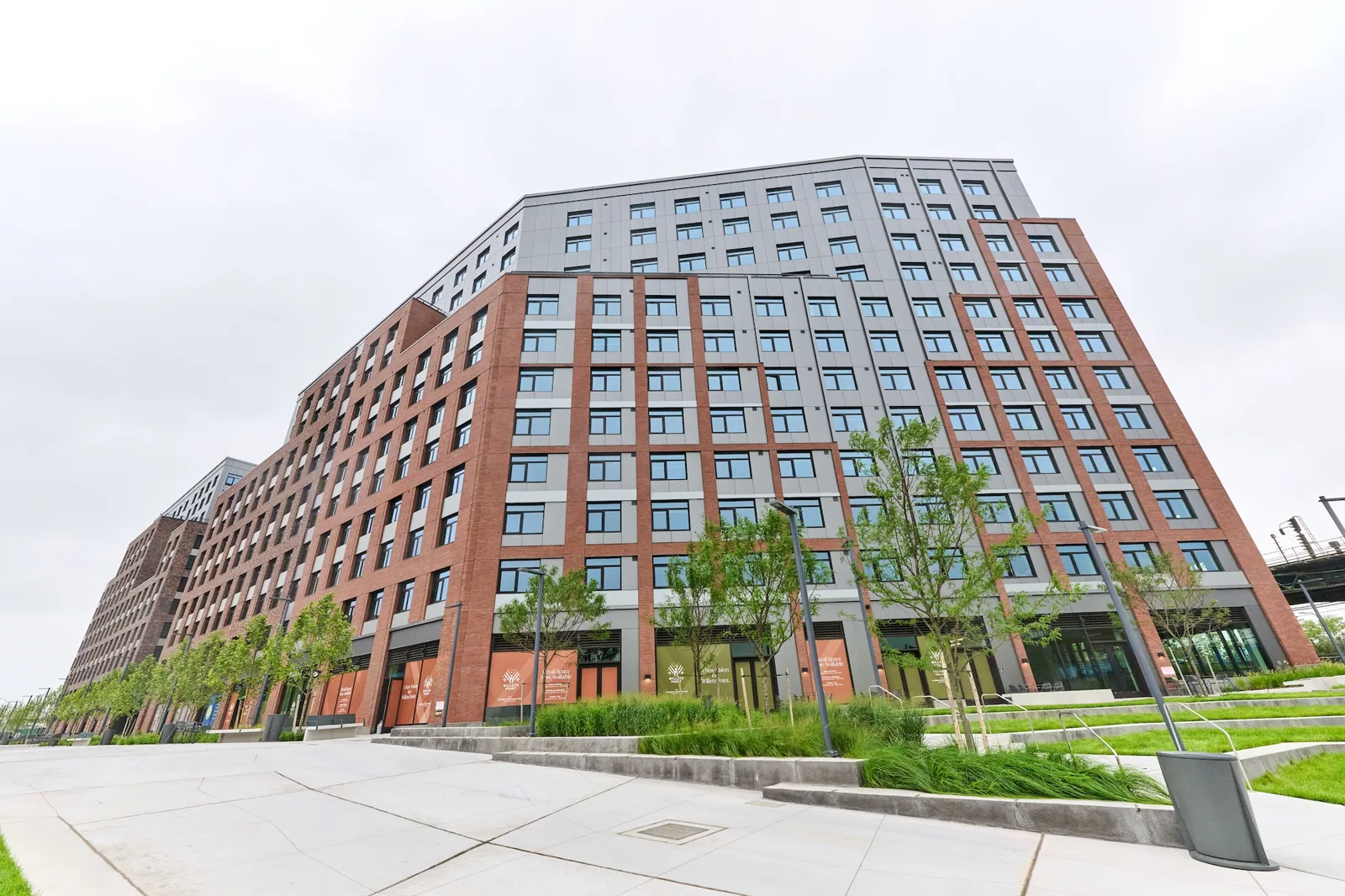
Willets Point
Commercial roofing in Willets Point, Queens, NY: roofs on shop and light-industrial buildings, drainage on flood-prone ground and repair planning around change.
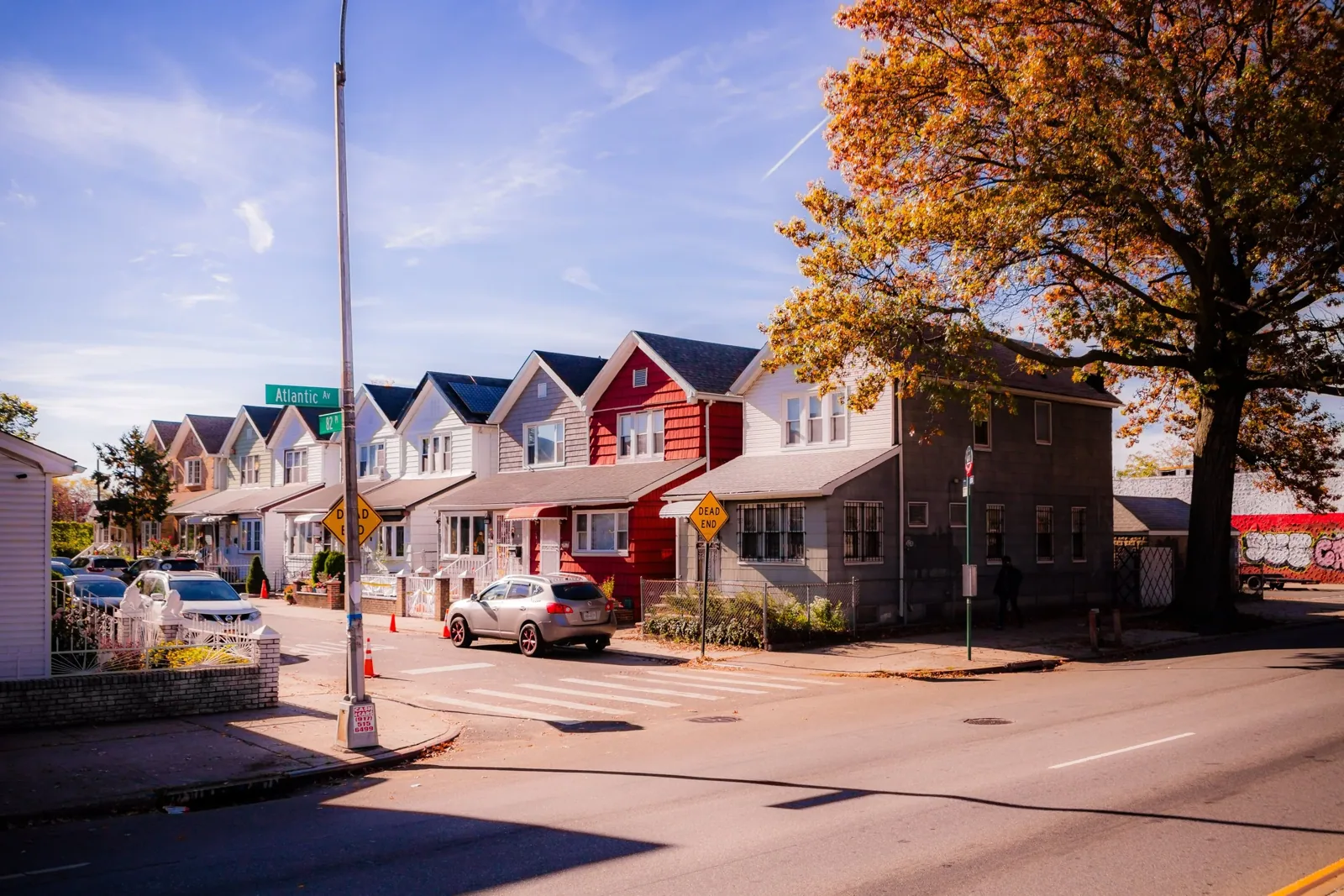
Ozone Park
Commercial roofing in Ozone Park, Queens, NY: Liberty Avenue and Rockaway Boulevard shop roofs, reused industrial buildings, hospitality roofs and drain repair.
Ready to Talk About Auto Dealership Roofing?
Tell us about the building and what you are seeing. We will schedule a roof walk and send photos and a written scope.